Conflicts were all co-located additions rather than design collisions:
- GCode.cpp: adopt upstream's toolchange(filament_id, nozzle_id) signature and
  per-variant set_config_index() while keeping the IMEX bare-T<n> suppression;
  rebase the second-layer temperature loop's non-IMEX branch onto upstream's
  get_filament_config_index() resolution.
- Preset.cpp / PresetBundle.cpp / PrintConfig.cpp: keep both sides' option-list
  and enum-map entries.
- GLCanvas3D.cpp: upstream's printable_heights argument plus the IMEX ghost pass.
- PartPlate.cpp: keep <set> (still used).
- test_gcodewriter.cpp / test_3mf.cpp: keep both sides' test cases.
Resolves two conflicts:
- GLCanvas3D.hpp: keep both the IMEX ghost render declarations and
  upstream's _render_wireframe_overlay().
- test_gcodewriter.cpp: both sides appended test cases to the same
  region; keep upstream's origin/machine-limit tests alongside the
  pressure-advance and temperature scenarios.
* Fix issue that switching printer profile is slow.
`wxGetApp().get_tab(preset_type)->select_preset(preset_name);` is called twice when switching printer profiles. Only one needed.

* Avoid unnecessary type conversion & function call during printer profile switching:
- Don't call `config->opt_string("printer_model")` repeatedly
- Use ref when possible during iterating
- Avoid unnecessary `wxString` to `std::string` conversion
HoverLabel's constructor used SetSizerAndFit, which records the
count-hidden width as the panel's explicit minimum size. An explicit
minimum outranks best size in sizer allocation, so once the "(N)" count
was shown, any ancestor Layout() - e.g. switching the extruder flow type
to Standard or High Flow - shrank the title row back to the stale width
and clipped the trailing edit button. Hybrid only appeared correct while
nothing had re-laid the row since its own Fit().

Use plain SetSizer and, on every title/count change, invalidate the
cached best size and re-lay both the row and its parent so the sizer
always allocates the current content width.
- FilamentMapDialog's manual page understands volume types: a mixed
  (Hybrid) extruder shows separate Standard / High Flow drop zones
  with live sub-nozzle counts, a validation timer with an inline
  error + "set nozzle count" suggestion, and composes a per-filament
  volume map on OK (persisted to the plate or globally)
- switching an extruder's Flow type rewrites the affected plate map
  entries; plate maps stay sized across filament add/delete/count
  changes (values keep their filament, no index shift)
- CLI: manual mapping on multi-nozzle printers synthesizes the volume
  map from extruder flow types when absent; nozzle-manual mode
  requires explicit maps; computed maps land on the plate so exported
  projects carry filament_volume_maps
- filament_nozzle_map joins the project options (selection seeding +
  filament-count resizing)
- pot entries for the new dialog strings

All 19 reference fixtures byte-identical; slicing an exported Hybrid
project reproduces its g-code byte-for-byte with the volume map
round-tripped through model_settings.config.
- Print::update_filament_maps_to_config takes filament/volume/nozzle
  maps, backfills an empty volume map from extruder types, rebuilds
  filament_map_2, re-expands the per-filament variant arrays, and
  recomputes retract overrides keyed by resolved slots
- grouping writes its result back in every non-sequential mode;
  manual multi-nozzle grouping validates the user mapping and raises a
  translatable error on deviation; the engine's concrete volume
  assignment is deliberately not merged yet (per-filament arrays are
  already consumed by filament id, so materializing High Flow now
  would change motion before the layer-aware resolvers land)
- Print::apply treats the three map keys as engine outputs in auto
  modes (erased from the diff and adopted), compares them against used
  filaments in manual mode, and keeps the pre-expansion snapshot in
  sync with the late normalization pass so rebuilt headers reflect the
  sliced state instead of resurrecting stale values
- volume/nozzle maps and extruder_nozzle_stats join the invalidation
  group of filament_map (wipe tower + skirt/brim)
- PresetBundle composes full configs with an optional per-filament
  volume map (plate map, else defaults derived from each extruder's
  flow type); project config keeps the map sized across filament
  count changes
- PartPlate stores per-plate volume/nozzle maps; Plater injects them
  at every slice-composition site (incl. g-code reload and wipe-tower
  estimation); BackgroundSlicingProcess reads engine results back to
  the plate in auto modes
- per-filament map trust guards relaxed to size-match everywhere now
  that every producer sizes the map; single-filament explicit flow
  assignments are honored
- tests: grouping volume maps stay concrete, merge semantics of
  update_used_filament_values, single-filament override honoring

Motion g-code is byte-identical fleet-wide including Hybrid projects
(19-fixture gate + repro determinism double-slice). Header deltas:
the map keys now dump real values, and stale pre-normalization values
(e.g. enable_prime_tower on single-used-filament prints) no longer
leak into the config block.
The sidebar extruder cards get an interactive title row — "<name> ( <count> )"
with an edit button — showing the extruder's physical nozzle count on
multi-nozzle printers (hidden elsewhere). Clicking it opens the existing
"Set nozzle count" dialog, which now also handles a Hybrid extruder by
offering both Standard and High Flow counts (an empty mix is rejected) and
shows a hotend thumbnail.

Because `extruder_nozzle_stats` is session-only (saved presets never carry
it, so preset switches rebuild the edited config without it), the stats are
re-baselined whenever they are missing: each extruder starts with
extruder_max_nozzle_count nozzles of its selected volume type. Switching an
extruder's flow type carries its total count over to the new type, except
when the stats came from a device sync — the machine-reported per-type
breakdown must survive a manual flow switch.

The badge refreshes on preset load, flow-type change, manual edit, device
sync, and project load. Single-extruder cards keep the title row but never
enable editing.
An extruder with more than one physical sub-nozzle can hold a mix of
Standard and High Flow nozzles. The Flow dropdown now offers Hybrid for
such extruders (extruder_max_nozzle_count > 1, nil-guarded); grouping
already expands a Hybrid extruder into per-volume nozzle groups from
extruder_nozzle_stats.

- sidebar Flow combo offers Hybrid only for multi-sub-nozzle extruders
- preset lookup treats Hybrid as Standard (presets define no Hybrid
  variant); variant strings are never fabricated for it
- printer tab splits a Hybrid extruder into Standard + High Flow rows,
  with matching selection-index arithmetic and sync-enable rules
- syncing from a printer whose extruder holds mixed nozzle flows now
  selects Hybrid instead of collapsing to the dominant flow type
- send-to-printer flow check: a nozzle-rack extruder validates its
  nozzle inventory (mounted + rack) against every needed flow instead
  of comparing only the mounted nozzle; mounted-flow lookup is now
  per-extruder, fixing an index shift when a nozzle reports no flow
- Hybrid is session-only in app config (stored as Standard), so a
  fresh session starts from concrete flow types

Printers whose extruders have a single sub-nozzle (including all
dual-extruder machines without a rack) see no new option and identical
check behavior.
The engine already implements prime_volume_mode (Default/Saving/Fast)
but nothing in the UI could set it, leaving prime-saving unreachable on
multi-sub-nozzle extruders and fast purge unreachable on printers that
support it.

- new PurgeModeDialog with selectable Standard/Fast or
  Standard/Prime Saving cards depending on printer capability
- "Purge mode" sidebar button next to Flushing volumes; opens the
  dialog and stores the choice in the project config
- printer preset-load gating: button shown only when the printer has
  multiple sub-nozzles per extruder or sets support_fast_purge_mode;
  stale project values the printer cannot honor reset to Default
- enable fast purge on A2L 0.4 (support_fast_purge_mode), explicit
  default 0 in the common machine base
- new dialog strings added to OrcaSlicer.pot

Printers without these capabilities never show the button and their
projects keep prime_volume_mode at Default, so slicing output is
unchanged.
The Filament Track Switch (H2-series accessory, product code O2L-FTS) feeds
every AMS to both extruders through a two-track switch. Port full support
across the device layer, project config, and GUI.

Device / config:
- Model the switch-aware AMS binding (the set of extruders an AMS can feed
  and which input track A/B feeds it), switch readiness, the O2L-FTS firmware
  module, and the fun2 capability bit for checking a slice against installed
  hardware.
- Register has_filament_switcher and enable_filament_dynamic_map as project
  config that persists with the project and restores from a saved 3mf, and
  force both back to false on every project/printer/CLI load path. Live
  device sync is the only thing that sets them true.

GUI:
- Sidebar sync activates the switch from live device state, attributes each
  AMS to the extruder its input track feeds, shows a floating status icon
  (ready / not-calibrated), and surfaces a one-time tip / not-calibrated
  warning.
- Send dialog gains a non-blocking slice-vs-hardware mismatch warning and a
  blocking error when a slice needs dynamic nozzle mapping but the switch is
  missing or not set up.
- AMS load/unload guards, AMS-view routing glyph + un-calibrated banner +
  hidden external-spool road, and mapping-popup external-spool lockout.
- Filament pickers collapse the per-extruder split into a single deduplicated
  "AMS filaments" group with a smart-assign toggle when the switch is ready.
- Firmware-upgrade panel lists the O2L-FTS accessory and its version.
- Device-provided filament-change steps (ams.cfs) drive the change-step
  display when firmware sends them, including the three switch steps.
- "Load current filament" asks which extruder to feed via a
  FeedDirectionDialog when the switch is calibrated.

Inert without the accessory: every path is gated on the switch being
installed (MQTT aux bit 29, default off) or ready, both project flags default
false, and the per-extruder AMS attribution is byte-identical, so AMS state,
the send/load UI, and sliced g-code are unchanged for every printer that does
not report a Filament Track Switch.
Multi-nozzle sync widget, AMS rack-nozzle mapping popup, calibration rework, send-dialog nozzle mapping and extruder-count UI. Includes the fix to persist the AMS sync badge on filament cards (H2C/A2L and direct-sync printers).
* fix: isolate calibration temp paths per user

The calibration temp files under <temp>/calib were file-scope statics
initialized before set_temporary_dir() runs at startup, so they kept
using the shared system temp root and missed the per-user isolation
added in #14607. On Linux every account shares /tmp, so the first user
to calibrate owns /tmp/calib and later users fail to write there, the
same cross-user collision #14607 fixed for model backups, STEP import,
and part skip.

Build the paths lazily from temporary_dir() instead, through a
calib_temp_dir() accessor and a calib_temp_file() join helper. The base
becomes <temp>/orcaslicer_<uid>/calib on Linux and is unchanged on
Windows, where the temp dir is already per user.

Also make StoreParams::path a std::string rather than a non-owning
const char*. The calibration code had to keep a std::string alive
solely to feed that pointer, and the field was uninitialized by
default; owning the string removes the lifetime hazard for all three
callers and makes the entry guard a reliable empty() check. Confined to
the 3mf project exporter (three callers, two internal reads); no
on-disk, format, or ABI impact.

Follows up on #14607 per @Noisyfox's review suggestion.
* Fix reload from disk for STEP models after reopening a project (#12992)

reload_from_disk matched reloaded source volumes with an exact
source.input_file string comparison. After a project is saved and
reopened, the stored source path is only the filename (the default,
non-full-path save) while a freshly re-imported volume carries a full
path, so the comparison never matched: reload fell into fail_list and
the "locate file" dialog was effectively useless for STEP models.

Fall back to a case-insensitive filename comparison when the exact
paths differ, so the existing same-folder source lookup (and the
locate dialog) can reload the model. Projects that stored absolute
source paths still match exactly as before; no 3mf format change.

* Add Preferences option to store full source paths in projects

Expose the existing export_sources_full_pathnames setting (previously
only editable in the config file) as a checkbox under Preferences >
General > Project. Enabling it stores absolute source paths in saved
projects, so "Reload from disk" works when the source file is kept in
a different folder than the project (companion to #12992).
Catches the iXex/IDEX branch up to upstream main (44 commits). One
content conflict resolved:

- src/libslic3r/Print.hpp: kept upstream's default-initialized
  m_origin {0,0,0} alongside our m_imex_slice_offset member.

Co-Authored-By: Claude Opus 4.8 (1M context) <noreply@anthropic.com>
Catches the iXex/IDEX parallel-printing branch up to upstream main
(102 commits). Two content conflicts resolved:

- src/libslic3r/Preset.cpp: s_Preset_printer_options — kept upstream's
  new "use_3mf" key and our iMEX printer-capability/mode keys.
- tests/fff_print/test_gcodewriter.cpp: upstream revived the disabled
  suite (#14196), dropping the obsolete [.]-tagged lift() test and its
  config_lift_unlift.ini; kept their set_speed + z_hop tests and appended
  our 10 per-firmware set_pressure_advance/set_temperature scenarios.

Co-Authored-By: Claude Opus 4.8 (1M context) <noreply@anthropic.com>
feat: forward plateindex for index-coded .gcode.3mf uploads

Gcode inside a .gcode.3mf is index-coded (Metadata/plate_<N>.gcode) and a
bundle may carry several, so the upload must name which plate to print —
even a single-plate bundle, since its entry is still indexed.

A 1-based plate index is stored in PrintHostUpload::extended_info when use_3mf
is set; the OctoPrint and Moonraker hosts forward it as a `plateindex` form
field. Servers that don't use it ignore the unknown field, so the plain G-code
path is unchanged.
* Degrees symbol don't need localization

* The Z when referring to the axis should be uppercase

* Fix the spelling of "GitHub" to camelcase

* Unify the casing of mouse button shortcuts

* Always use G-code with an hyphen

* Fix the spelling of "restricted"

* More grammar fixes

* add missing modifications

---------

Co-authored-by: SoftFever <softfeverever@gmail.com>
* feat: add support for 3MF file format in printer configurations and export options

* fix file extension

* enable 3mf for X Max 4

* disable use_3mf for X Plus 4

* Fixed an issue where `label_object_enabled` was not properly propagated to 3mf

* enable exclude object for Max 4

* remove hardcoded use 3mf for flashforge, move them to the new printer profiles config
124 upstream commits including CrealityPrint integration (added include
in Plater.cpp alongside the existing IMEXHelpers include), profile fixes
and version bumps (#14084, #14085, Polymaker), CI artifact publishing,
test refactors (arachne walls test added; test_3mf/test_config/
test_gcodewriter content moved/removed upstream — IMEX test file
preserved as it is feedback-only), translations.
## Summary
Adds end-to-end Creality K-series (K2 / K2 Plus / K2 Pro) host support
to OrcaSlicer in a single bundle, per [@SoftFever's request to
consolidate](https://github.com/OrcaSlicer/OrcaSlicer/pull/13752#issuecomment-4560837450)
the previously stacked PRs. Three logically separable features, all
gated on `host_type=crealityprint`:
1. **LAN auto-discovery** — `Browse...` in the Physical Printer dialog
now finds K-series printers on the local network via a DNS-SD
meta-browser (per-device-unique service names
`_Creality-<MAC>._udp.local.`). Other host types unchanged.
2. **CFS filament sync** — `CrealityPrintAgent` (inheriting
`MoonrakerPrinterAgent`) queries the K-series WebSocket on `:9999` for
`boxsInfo`, maps loaded CFS slots to Orca filament presets, and
populates the Sidebar via the standard `fetch_filament_info` →
`build_ams_payload` path. Matches the shape of `MoonrakerPrinterAgent` /
`QidiPrinterAgent` / `SnapmakerPrinterAgent` per [the earlier review
feedback](https://github.com/OrcaSlicer/OrcaSlicer/pull/13752#discussion_r3278574545).
3. **K-series filament profiles** — system profiles for CR-PLA / CR-PETG
/ CR-ABS / CR-Silk / CR-TPU / CR-Nylon / CR-Wood / Hyper PLA / etc. on
K2 / K2 Plus / K2 Pro nozzle sizes (imported from CrealityPrint v7.1.0+,
normalised to OrcaSlicer profile conventions).
The previous stack base (#13291, *CrealityPrint as host type*, by
@imammedo) is **also bundled into this PR** since it's currently
conflicting with main and not moving. Happy to extract it back out if
@imammedo's PR is preferred to land first for attribution — let me know.
## What this PR is *not*
- **No new UI surfaces.** All three features hook into existing UI
(Browse button, Sidebar sync icon, filament dropdowns).
- **No phone-home / telemetry.** No Hark Tech endpoints, no licence
checks, no opt-in dialogs. Pure upstream feature work.
- **No K-series-specific Device tab.** Embedded WebView falls back to
Fluidd/Mainsail on `:4408`, same shape as the existing Moonraker
integration.
## Screenshots
Captured against a K2 Combo (F021, firmware v1.1.260206) on the v4 test
build:
| | |
|---|---|
| 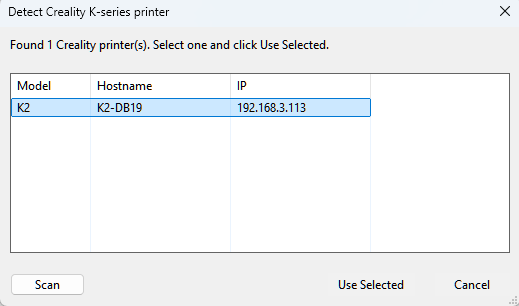
| **Discovery dialog** — `Browse...` flow on a `host_type=crealityprint`
printer. Click → ~5–10 s LAN scan → K2 found with model + hostname + IP.
|
| 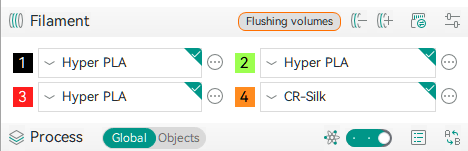
| **CFS filament sync** — Sidebar after clicking the sync icon: 4 slots
populate with the real loaded CFS spools (3× Hyper PLA + 1× CR-Silk). |
| 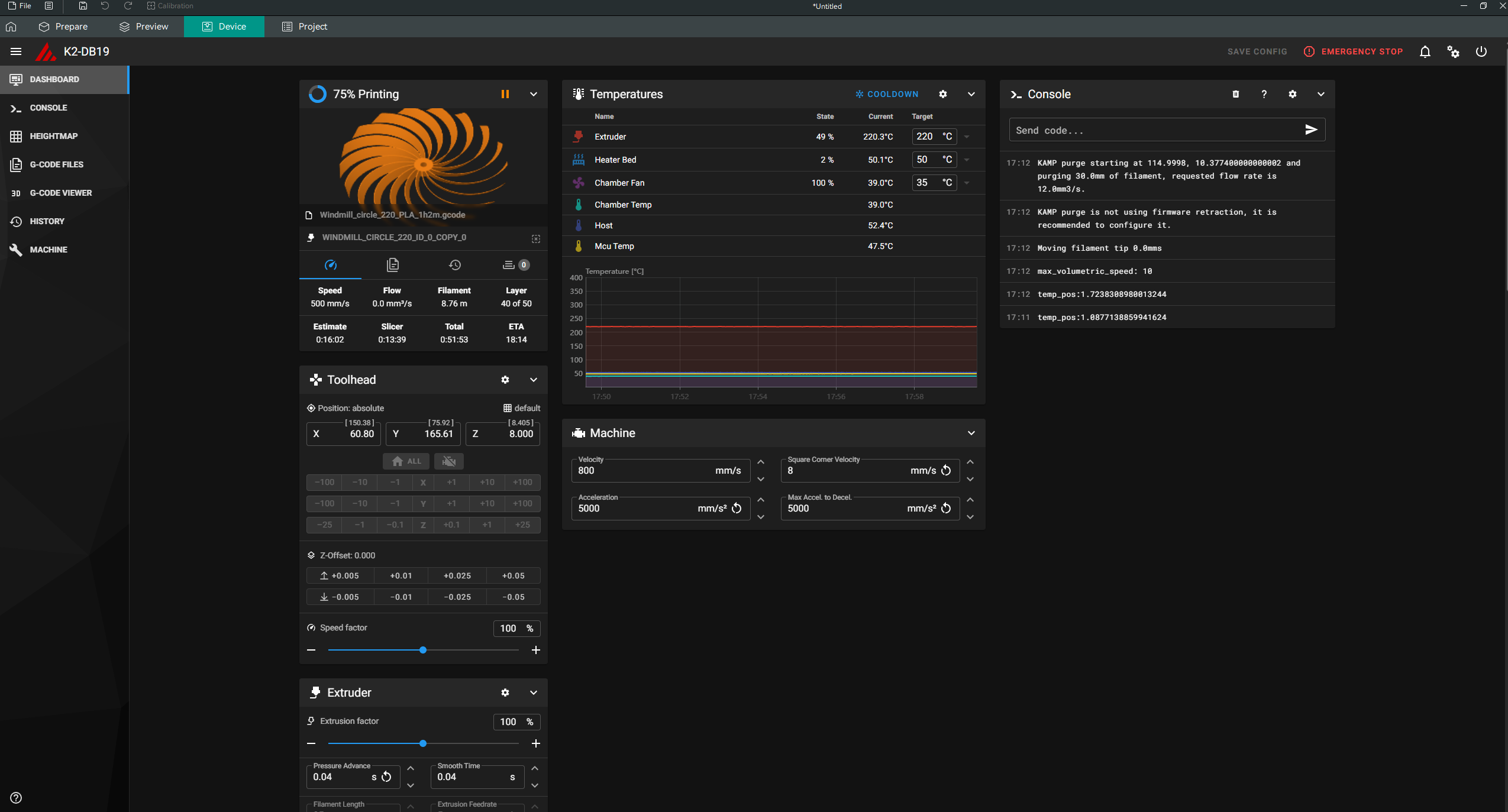
| **Device tab** — Mainsail loaded into the embedded WebView for
`host_type=crealityprint`, mid-print state visible. |
## What's added
### LAN discovery
- **`deps_src/mdns/`** — vendors
[mjansson/mdns](https://github.com/mjansson/mdns) (public domain) plus
Creality's `cxmdns` C++ wrapper from CrealityPrint v7.1.1 (AGPL-3.0,
compatible with OrcaSlicer's AGPL-3.0). Attribution in
`deps_src/mdns/NOTICE.md`.
- **`Utils/CrealityHostDiscovery.{hpp,cpp}`** — synchronous DNS-SD scan
+ per-host `GET /info` probe. Maps model codes `F008` / `F012` / `F021`
→ K2 Plus / K2 Pro / K2.
- **`GUI/CrealityDiscoveryDialog.{hpp,cpp}`** — modal `wxDialog` showing
Model / Hostname / IP for each discovered host.
- **`src/slic3r/CMakeLists.txt`** — adds `Iphlpapi.lib` and `Ws2_32.lib`
to `libslic3r_gui`'s MSVC link line (needed by `GetAdaptersAddresses` +
Winsock2 calls in vendored `mdns.c`).
### CFS filament sync
- **`Utils/CrealityPrintAgent.{hpp,cpp}`** — inherits
`MoonrakerPrinterAgent`, overrides `fetch_filament_info()` to query the
K-series WS protocol on `:9999`, build `AmsTrayData`, and call inherited
`build_ams_payload()`. No printer-specific code lives outside the agent.
- K2 Plus slot-state parser handles the three documented slot states
(`0` empty / `1` manually entered / `2` RFID-tagged) per [DaviBe92's
reverse-engineering docs](https://github.com/DaviBe92/k2-websocket-re).
### K-series filament profiles
- ~110 profile JSONs under `resources/profiles/Creality/filament/`
covering K2 / K2 Plus / K2 Pro × 0.2 / 0.4 / 0.6 / 0.8 nozzle combos ×
CR-PLA / CR-PETG / CR-ABS / CR-Silk / CR-TPU / CR-Nylon / CR-Wood /
Hyper PLA / Hyper PETG-GF / Hyper PLA-CF / etc.
- Imported from CrealityPrint v7.1.0; normalised to OrcaSlicer profile
conventions (tabs not spaces, no `{if !multicolor_method}` wrappers,
`filament_vendor: ["Creality"]` on Creality Generic profiles).
## Tester confirmations on the v4 test build
| Printer | Firmware | Result | Reporter |
|---|---|---|---|
| K2 Pro | v1.1.5.5 / CFS v1.4.2 | ✅ LAN discovery on #13752 test build
|
[@Requiem-MH](https://github.com/OrcaSlicer/OrcaSlicer/pull/13752#issuecomment-4495235225)
|
| K2 Pro | v1.1.5.5 / CFS v1.4.2 | ✅ CFS sync across 1-CFS, 2-CFS,
partial, full configurations |
[@Requiem-MH](https://github.com/OrcaSlicer/OrcaSlicer/pull/13744#issuecomment-4495230061)
|
| K2 Plus | v1.1.5.2 / CFS v1.2.2 | ✅ Slot-state fix resolves the
partial-sync regression |
[@DaviBe92](https://github.com/OrcaSlicer/OrcaSlicer/pull/13744#issuecomment-4499425852)
|
| K2 Plus | v1.1.5.5 / CFS v1.4.2 | ✅ All slots syncing correctly after
fix |
[@swilsonnc](https://github.com/OrcaSlicer/OrcaSlicer/pull/13744#issuecomment-4503273127)
|
| K2 Plus | (Reddit u/TrainAss) | ✅ Both PLA + PETG slots populated
correctly |
[@TrainAss](https://github.com/OrcaSlicer/OrcaSlicer/pull/13744#issuecomment-4503401664)
|
| K1C | (latest stock) | ✅ `boxsInfo` payload format compatible (4 slots
of generic PETG) |
[@JoveYu](https://github.com/OrcaSlicer/OrcaSlicer/pull/13744#issuecomment-4519036448)
|
## Known follow-ups (out of scope)
- **Snapmaker U1 regression**
([@TrainAss](https://github.com/OrcaSlicer/OrcaSlicer/pull/13744#issuecomment-4529350262)):
the v3 build also happened to sync filament from his U1; v4 regressed
this. The refactor only touches `htCrealityPrint`-gated code so this is
likely incidental — needs his config + logs to diagnose. Will follow up
in a separate issue once this lands.
- **Native Device tab for K-series**: deferred. Current Mainsail WebView
shim covers the common case.
- **#13581 (@hamham999) profile overlap**: confirmed minimal code
conflict (zero), profile-file overlap of ~204 files. Whichever PR lands
second rebases off the other.
## Test plan
- [x] Linux build clean on commit `<UPDATED AFTER BUILD>` (LXC 104, GCC
12, cmake)
- [x] MSVC link clean (manual VS 2026 / MSVC 14.51 build)
- [x] End-to-end on real hardware: K2 Combo, K2 Pro, K2 Plus, K1C
- [x] `host_type ≠ htCrealityPrint` paths unchanged — Bonjour fires for
OctoPrint, Flashforge picker fires for Flashforge, Moonraker / Qidi /
Snapmaker agents unchanged
- [x] Profile-validation CI green (was a separate Elegoo test-fixture
failure on main, not introduced by this PR)
Signed-off-by: Igor Mammedov <niallain@gmail.com>
Co-authored-by: Igor Mammedov <niallain@gmail.com>
Co-authored-by: grant0013 <grant@harktech.co.uk>
Co-authored-by: SoftFever <softfeverever@gmail.com>
Co-authored-by: hamham999 <hamham999@users.noreply.github.com>
Co-authored-by: Alys Andreollo <3528187+alysandreollo@users.noreply.github.com>
 Clifford Garwood


