Publish OrcaSlicer to the Snap Store (classic confinement) on channels
matching the release tiers: stable / candidate / beta / edge. The Linux
build (both arches) repackages the AppImage AppDir into a snap; nightly
builds go to edge, and tagged releases publish to the matching channel.

Stacked on the Linux ARM64 AppImage change.
Build the Linux AppImage for ARM64 (aarch64) alongside x86_64: the Linux CI
job now matrixes over both architectures, with arch-aware deps caching and
artifact/asset names (amd64 keeps its existing names). The aarch64 AppImage is
published to the nightly and release pages like the x86_64 one.

Run the unit-test suite on the aarch64 runner (faster GitHub arm runner); the
tests are built on that leg. Self-hosted keeps tests on the amd64 server.
* feat: add support for 3MF file format in printer configurations and export options

* fix file extension

* enable 3mf for X Max 4

* disable use_3mf for X Plus 4

* Fixed an issue where `label_object_enabled` was not properly propagated to 3mf

* enable exclude object for Max 4

* remove hardcoded use 3mf for flashforge, move them to the new printer profiles config
* docs: add MSIX Store build design spec

* docs: update MSIX spec (PFN deep link, .drc, Associate tab) and add implementation plan

* ci: add MSIX logo asset generator and generated assets

* ci: fix MSIX asset rendering edge bleed (PixelOffsetMode) and make output order deterministic

* ci: add MSIX AppxManifest template

* ci: add MSIX packaging script

* ci: make build_msix.ps1 stage-only exit dot-source safe

* ci: build MSIX Store package in Windows job

* ci: run MSIX pack after existing Windows uploads and keep it out of release downloads

* feat: add MSIX packaged-context detection helpers

* fix: resolve MSIX package APIs dynamically to keep Win7 loadable

* feat: suppress self-update in MSIX Store build

* feat: suppress runtime file associations in MSIX Store build

* feat: keep version check in MSIX build, point update dialog at the Store

The update check is notification-only (OrcaSlicer never auto-downloads),
so the Store build keeps checking for new versions instead of skipping
the check. What changes when packaged is the new-version dialog: the
Download button is hidden, the info text asks the user to update from
the Microsoft Store, and the hyperlink / wxID_YES action opens the Store
product page instead of the GitHub release page.

* docs: align spec verification plan with Store-redirect updater behavior

* feat: default MSIX identity to the reserved Partner Center values

* feat: render MSIX logos full-bleed from the gradient-circle SVG

* feat: point update dialog Download button at the Store in MSIX builds

* feat: link Associate tab to Windows Default Apps settings in MSIX builds

* docs: align spec with review-driven logo, dialog and Associate-tab changes

* clearn up
Switching to a printer with fewer filaments (e.g. H2D -> X2D) threw
std::out_of_range in check_filament_printable. Clear stale per-volume
extruder config on count shrink and bound-check filament indices at the
read sites.
## Summary
Adds end-to-end Creality K-series (K2 / K2 Plus / K2 Pro) host support
to OrcaSlicer in a single bundle, per [@SoftFever's request to
consolidate](https://github.com/OrcaSlicer/OrcaSlicer/pull/13752#issuecomment-4560837450)
the previously stacked PRs. Three logically separable features, all
gated on `host_type=crealityprint`:
1. **LAN auto-discovery** — `Browse...` in the Physical Printer dialog
now finds K-series printers on the local network via a DNS-SD
meta-browser (per-device-unique service names
`_Creality-<MAC>._udp.local.`). Other host types unchanged.
2. **CFS filament sync** — `CrealityPrintAgent` (inheriting
`MoonrakerPrinterAgent`) queries the K-series WebSocket on `:9999` for
`boxsInfo`, maps loaded CFS slots to Orca filament presets, and
populates the Sidebar via the standard `fetch_filament_info` →
`build_ams_payload` path. Matches the shape of `MoonrakerPrinterAgent` /
`QidiPrinterAgent` / `SnapmakerPrinterAgent` per [the earlier review
feedback](https://github.com/OrcaSlicer/OrcaSlicer/pull/13752#discussion_r3278574545).
3. **K-series filament profiles** — system profiles for CR-PLA / CR-PETG
/ CR-ABS / CR-Silk / CR-TPU / CR-Nylon / CR-Wood / Hyper PLA / etc. on
K2 / K2 Plus / K2 Pro nozzle sizes (imported from CrealityPrint v7.1.0+,
normalised to OrcaSlicer profile conventions).
The previous stack base (#13291, *CrealityPrint as host type*, by
@imammedo) is **also bundled into this PR** since it's currently
conflicting with main and not moving. Happy to extract it back out if
@imammedo's PR is preferred to land first for attribution — let me know.
## What this PR is *not*
- **No new UI surfaces.** All three features hook into existing UI
(Browse button, Sidebar sync icon, filament dropdowns).
- **No phone-home / telemetry.** No Hark Tech endpoints, no licence
checks, no opt-in dialogs. Pure upstream feature work.
- **No K-series-specific Device tab.** Embedded WebView falls back to
Fluidd/Mainsail on `:4408`, same shape as the existing Moonraker
integration.
## Screenshots
Captured against a K2 Combo (F021, firmware v1.1.260206) on the v4 test
build:
| | |
|---|---|
| 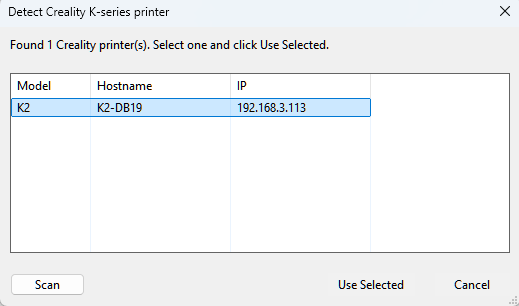
| **Discovery dialog** — `Browse...` flow on a `host_type=crealityprint`
printer. Click → ~5–10 s LAN scan → K2 found with model + hostname + IP.
|
| 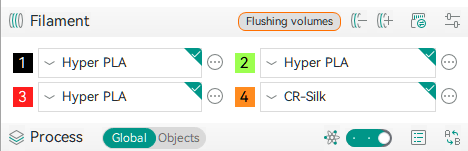
| **CFS filament sync** — Sidebar after clicking the sync icon: 4 slots
populate with the real loaded CFS spools (3× Hyper PLA + 1× CR-Silk). |
| 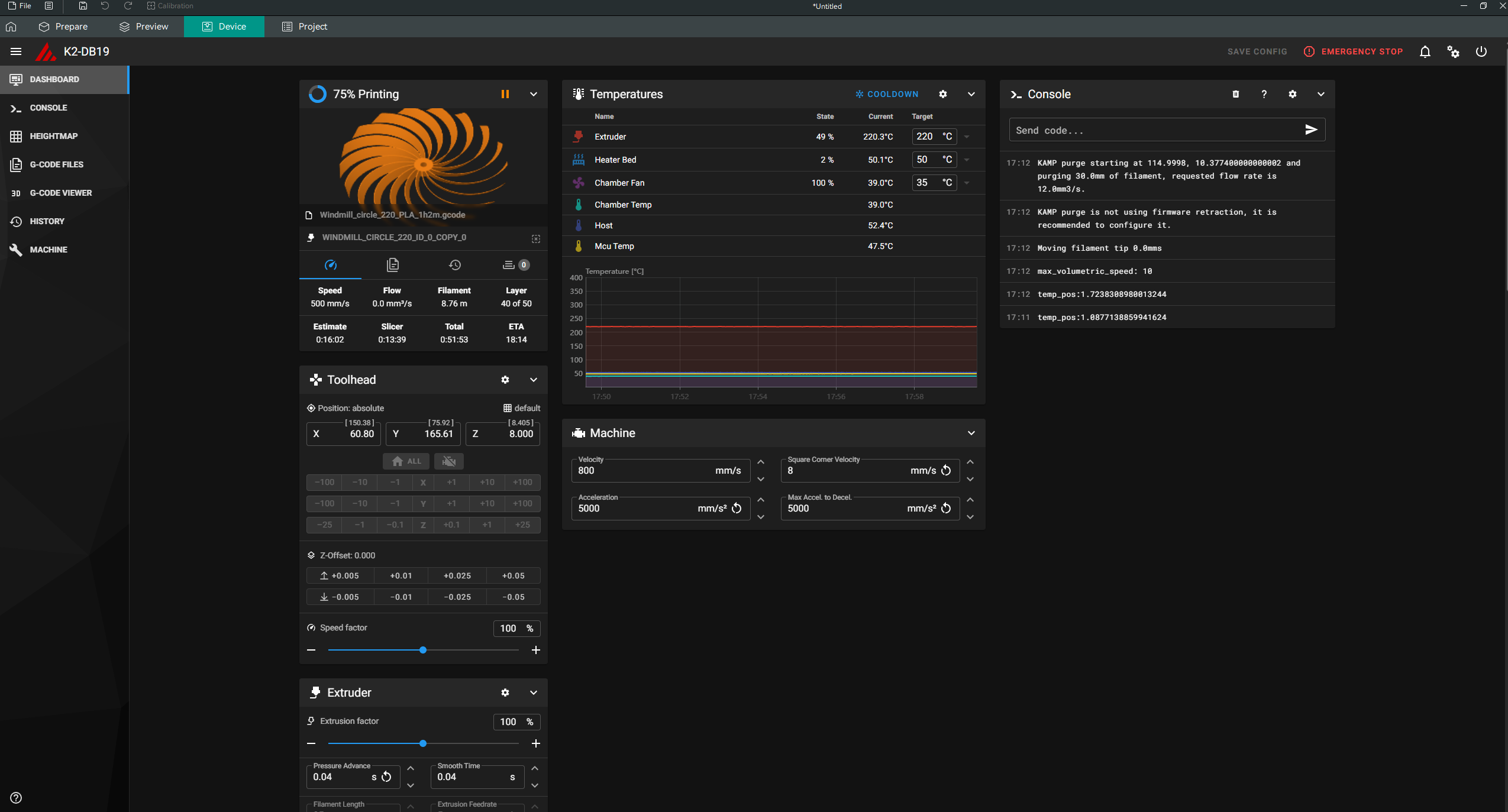
| **Device tab** — Mainsail loaded into the embedded WebView for
`host_type=crealityprint`, mid-print state visible. |
## What's added
### LAN discovery
- **`deps_src/mdns/`** — vendors
[mjansson/mdns](https://github.com/mjansson/mdns) (public domain) plus
Creality's `cxmdns` C++ wrapper from CrealityPrint v7.1.1 (AGPL-3.0,
compatible with OrcaSlicer's AGPL-3.0). Attribution in
`deps_src/mdns/NOTICE.md`.
- **`Utils/CrealityHostDiscovery.{hpp,cpp}`** — synchronous DNS-SD scan
+ per-host `GET /info` probe. Maps model codes `F008` / `F012` / `F021`
→ K2 Plus / K2 Pro / K2.
- **`GUI/CrealityDiscoveryDialog.{hpp,cpp}`** — modal `wxDialog` showing
Model / Hostname / IP for each discovered host.
- **`src/slic3r/CMakeLists.txt`** — adds `Iphlpapi.lib` and `Ws2_32.lib`
to `libslic3r_gui`'s MSVC link line (needed by `GetAdaptersAddresses` +
Winsock2 calls in vendored `mdns.c`).
### CFS filament sync
- **`Utils/CrealityPrintAgent.{hpp,cpp}`** — inherits
`MoonrakerPrinterAgent`, overrides `fetch_filament_info()` to query the
K-series WS protocol on `:9999`, build `AmsTrayData`, and call inherited
`build_ams_payload()`. No printer-specific code lives outside the agent.
- K2 Plus slot-state parser handles the three documented slot states
(`0` empty / `1` manually entered / `2` RFID-tagged) per [DaviBe92's
reverse-engineering docs](https://github.com/DaviBe92/k2-websocket-re).
### K-series filament profiles
- ~110 profile JSONs under `resources/profiles/Creality/filament/`
covering K2 / K2 Plus / K2 Pro × 0.2 / 0.4 / 0.6 / 0.8 nozzle combos ×
CR-PLA / CR-PETG / CR-ABS / CR-Silk / CR-TPU / CR-Nylon / CR-Wood /
Hyper PLA / Hyper PETG-GF / Hyper PLA-CF / etc.
- Imported from CrealityPrint v7.1.0; normalised to OrcaSlicer profile
conventions (tabs not spaces, no `{if !multicolor_method}` wrappers,
`filament_vendor: ["Creality"]` on Creality Generic profiles).
## Tester confirmations on the v4 test build
| Printer | Firmware | Result | Reporter |
|---|---|---|---|
| K2 Pro | v1.1.5.5 / CFS v1.4.2 | ✅ LAN discovery on #13752 test build
|
[@Requiem-MH](https://github.com/OrcaSlicer/OrcaSlicer/pull/13752#issuecomment-4495235225)
|
| K2 Pro | v1.1.5.5 / CFS v1.4.2 | ✅ CFS sync across 1-CFS, 2-CFS,
partial, full configurations |
[@Requiem-MH](https://github.com/OrcaSlicer/OrcaSlicer/pull/13744#issuecomment-4495230061)
|
| K2 Plus | v1.1.5.2 / CFS v1.2.2 | ✅ Slot-state fix resolves the
partial-sync regression |
[@DaviBe92](https://github.com/OrcaSlicer/OrcaSlicer/pull/13744#issuecomment-4499425852)
|
| K2 Plus | v1.1.5.5 / CFS v1.4.2 | ✅ All slots syncing correctly after
fix |
[@swilsonnc](https://github.com/OrcaSlicer/OrcaSlicer/pull/13744#issuecomment-4503273127)
|
| K2 Plus | (Reddit u/TrainAss) | ✅ Both PLA + PETG slots populated
correctly |
[@TrainAss](https://github.com/OrcaSlicer/OrcaSlicer/pull/13744#issuecomment-4503401664)
|
| K1C | (latest stock) | ✅ `boxsInfo` payload format compatible (4 slots
of generic PETG) |
[@JoveYu](https://github.com/OrcaSlicer/OrcaSlicer/pull/13744#issuecomment-4519036448)
|
## Known follow-ups (out of scope)
- **Snapmaker U1 regression**
([@TrainAss](https://github.com/OrcaSlicer/OrcaSlicer/pull/13744#issuecomment-4529350262)):
the v3 build also happened to sync filament from his U1; v4 regressed
this. The refactor only touches `htCrealityPrint`-gated code so this is
likely incidental — needs his config + logs to diagnose. Will follow up
in a separate issue once this lands.
- **Native Device tab for K-series**: deferred. Current Mainsail WebView
shim covers the common case.
- **#13581 (@hamham999) profile overlap**: confirmed minimal code
conflict (zero), profile-file overlap of ~204 files. Whichever PR lands
second rebases off the other.
## Test plan
- [x] Linux build clean on commit `<UPDATED AFTER BUILD>` (LXC 104, GCC
12, cmake)
- [x] MSVC link clean (manual VS 2026 / MSVC 14.51 build)
- [x] End-to-end on real hardware: K2 Combo, K2 Pro, K2 Plus, K1C
- [x] `host_type ≠ htCrealityPrint` paths unchanged — Bonjour fires for
OctoPrint, Flashforge picker fires for Flashforge, Moonraker / Qidi /
Snapmaker agents unchanged
- [x] Profile-validation CI green (was a separate Elegoo test-fixture
failure on main, not introduced by this PR)
Signed-off-by: Igor Mammedov <niallain@gmail.com>
Co-authored-by: Igor Mammedov <niallain@gmail.com>
Co-authored-by: grant0013 <grant@harktech.co.uk>
Co-authored-by: SoftFever <softfeverever@gmail.com>
Co-authored-by: hamham999 <hamham999@users.noreply.github.com>
Co-authored-by: Alys Andreollo <3528187+alysandreollo@users.noreply.github.com>
* Update the stealth mode description to reflect the current code changes in 2.4.

* disable HMS if bambu network plugin is not installed or in stealth mode

* fix build err

* add hide_login_side_panel to control whether to show login panel in home page
Wire the existing disassociate_url path into the Associate-tab
checkbox so users can revert prusaslicer/bambustudio/cura
registrations they previously enabled.
After pulling the latest presets from the cloud, changed values such as Layer height kept showing the old value until the user switched tabs. Refresh the active settings tab on sync so updates appear immediately.
GridCellSupportEditor::DoActivate dereferenced
grid->GetSelectedBlocks().begin() without checking against end(). In
wxWidgets 3.1.5 that range always contained at least one block; in 3.3.2
it is empty after the user deselects, and the dereference crashes inside
wxGridBlockCoords::GetLeftCol().

Fall back to the (row, col) that triggered activation when the selection
is empty, so the existing single-cell branch handles it. While here,
drop a dead local_table cast that was never read.
Use glBlendFuncSeparate in GLTexture::render_sub_texture so destination
  alpha stays at 1.0. The Wayland compositor honors framebuffer alpha for     window compositing; the previous straight-alpha blend reduced dst alpha
  at anti-aliased icon edges, making them semi-transparent against the
  desktop. RGB blending is unchanged, so X11/Windows/macOS are unaffected.
Delay opening the object-list filament dropdown on wxGTK until the editor
  window is mapped, avoiding popup creation without a valid native toplevel.
  Also set the GTK transient parent for dropdown popups created from data-view
  cell editors.
load_selections() and update_selections() size the parallel project_config
arrays (filament_colour, filament_colour_type, filament_map) off
filament_presets.size(). When the saved list is shorter than the printer's
nozzle count — never-used printer, hand-trimmed conf, or fewer filament_NN
entries than nozzles — the loaded colors get truncated and the sidebar
starts up one combo short.
fix: eliminate UI freeze during cloud preset sync on startup
  Move synchronous HTTP calls off the main thread in
  GUI_App::start_sync_user_preset():

  - Call scan_orphaned_info_files() and process_delete_presets() in
    the background sync thread instead of the UI thread, so their
    HTTP DELETE calls don't block startup.
  - Call reload_settings() directly from the background thread
    instead of via CallAfter, so get_user_presets() (HTTP GET) and
    load/save_user_presets (file I/O) run off the main thread.
  - Guard update_side_preset_ui() and app_config->save() with
    is_main_thread_active() / CallAfter so they're safe when called
    from a worker thread.
  - Simplifiy finishFn lambdas: the progress-dialog case only
    destroys the dialog; the no-dialog case is a no-op.
On macOS, PopupWindow::OnMouseEvent2 synthesizes a wxEVT_ENTER_WINDOW on
`this` whenever the hovered target transitions from a child back to the
popup itself. wxPopupTransientWindow's OnIdle re-acquires mouse capture
once the cursor leaves the popup, so the next MOTION (with the cursor
already outside) hits OnMouseEvent2 with no child and synthesizes ENTER
on the popup — which would otherwise cancel the dismissal timer started
by OnLeaveWindow. Verify the cursor is actually inside before resetting.
Hovering a group item (e.g. "Generic" in the filament list) now opens
its submenu correctly. The dropdown stays usable while moving the
cursor between the parent list and the submenu, and dismisses normally
when the user clicks outside.
* fix: manual filament change not emitting MANUAL_TOOL_CHANGE for BBL printers
BBL-specific M1020 S handling in toolchange() bypassed toolchange_prefix(),so manual_filament_change had no effect — M1020 was always emitted regardless of the setting. Move the BBL logic into toolchange_prefix() so all callers respect the option consistently.
Fixes#11795
* add comment
# Description

With this change, builds on ARM64 hosts will successfully kick off!
Unfortunately there are still missing/outdated dependencies, so the
build doesn't yet succeed. This makes it much easier to check what we're
failing on though.
I've also added the processor/arch to "Unknown X" error messages for
easier debugging.

Follow-up to #10183

Affects #5783

# Screenshots/Recordings/Graphs

N/A

## Tests

Kicked off `build_release_vs.bat` on my Windows ARM machine. Observed
progress in the build process!

<!--
> A guide for users on how to download the artifacts from this PR.
-->

[How to Download Pull Requests Artifacts for
Testing](https://www.orcaslicer.com/wiki/how_to_download_pr_artifacts)
This PR supersedes #12225, which originally proposed this feature but
appears inactive.

The feature originated from work I developed earlier in
[BambuStudio-ZAA](https://github.com/adob/BambuStudio-ZAA), a private
fork of Bambu Studio

Compared to #12225, I updated the implementation for current upstream
and fixed the following issues:
 - fixed broken tests
 - removed references to nonplanar directory

Reviewers may want to compare against #12225 for earlier
discussion/context.

## Summary

Port of **Z Anti-Aliasing (ZAA)** from
[BambuStudio-ZAA](https://github.com/adob/BambuStudio-ZAA) to
OrcaSlicer.

ZAA eliminates visible stair-stepping on curved and sloped top surfaces
by raycasting each extrusion point against the original 3D mesh and
micro-adjusting its Z height to follow the actual surface geometry. The
result is visibly smoother domes, chamfers, and shallow slopes — without
post-processing.

## How It Works

1. The slicer runs normally, then a **posContouring** step processes
each layer
2. `ContourZ.cpp` raycasts every extrusion point vertically against the
source mesh
3. Each point's Z is adjusted to the mesh intersection, converting flat
`Polyline` paths into `Polyline3` paths with per-point Z coordinates
4. The G-code writer emits the adjusted Z values, so the printer follows
the true surface

## Configuration

Five new settings under **Print Settings > Quality**:

| Setting | Type | Default | Description |
|---------|------|---------|-------------|
| `zaa_enabled` | bool | off | Master enable/disable switch |
| `zaa_min_z` | float | 0.06 mm | Minimum Z layer height; controls
slicing plane offset |
| `zaa_minimize_perimeter_height` | float | 35° | Reduce perimeter
heights on slopes below this angle (0 = disabled) |
| `zaa_dont_alternate_fill_direction` | bool | off | Keep fill direction
consistent instead of alternating |
| `zaa_region_disable` | bool | off | Disable ZAA for a specific print
region/material |

## Key Changes

- **Core algorithm**: New `src/libslic3r/ContourZ.cpp` (~330 lines) —
raycasting engine
- **3D geometry**: `Point3`, `Line3`, `Polyline3`, `MultiPoint3` extend
existing 2D types
- **Arc fitting**: Templated to work with both 2D and 3D geometry
- **Pipeline**: `ExtrusionPath::polyline` changed from `Polyline` to
`Polyline3`; new `posContouring` step in `PrintObject.cpp`
- **G-code**: `GCode.cpp` writes per-point Z when `path.z_contoured` is
set
- **UI**: ZAA settings exposed in Print Settings > Quality panel
- **Documentation**: `docs/ZAA.md` with usage and implementation details

57 files changed, ~1800 insertions, ~200 deletions.

## Test Plan

- [ ] Load a model with curved top surfaces (sphere, dome, chamfered
box)
- [ ] Enable **Z contouring** in Print Settings > Quality
- [ ] Slice and verify G-code has varying Z values within contoured
layers
- [ ] Build on macOS (verified), test on Linux and Windows
* Add OrcaCloud sync platform and preset bundle sharing system

  Introduce OrcaCloud, a cloud sync platform for user presets, alongside
  a preset bundle system that enables sharing printer/filament/process
  profiles as local exportable bundles or subscribed cloud bundles.

  OrcaCloud platform:
  - Auth to Orca Cloud
  - Encrypted token storage (file-based or system keychain)
  - User preset sync with
  - Profile migration from default/bambu folders on first login
  - Homepage integration with entrance to cloud.orcaslicer.com

  Preset bundles:
  - Local bundle import/export with bundle_structure.json metadata
  - Subscribed cloud bundles with version-based update checking
  - Thread-safe concurrent bundle access with read-write mutex
  - Canonical bundle preset naming (_local/<id>/... and _subscribed/<id>/...)
  - Bundle presets are read-only; grouped under subheaders in combo boxes
  - PresetBundleDialog with auto-sync toggle, refresh, update notifications
  - Hyperlinked bundle names to cloud bundle pages

  Co-authored-by: Sabriel Koh <sabrielkcr@gmail.com>
  Co-authored-by: Derrick <derrick992110@gmail.com>
  Co-authored-by: Mykola Nahirnyi <mnahirnyi@amcbridge.com>
  Co-authored-by: Ian Chua <iancrb00@gmail.com>
  Co-authored-by: Draginraptor <draginraptor@gmail.com>
  Co-authored-by: ExPikaPaka <112851715+ExPikaPaka@users.noreply.github.com>
  Co-authored-by: Ian Bassi <ian.bassi@outlook.com>
  Co-authored-by: Ocraftyone <Ocraftyone@users.noreply.github.com>
  Co-authored-by: yw4z <ywsyildiz@gmail.com>
  Co-authored-by: peterm-m <101202951+peterm-m@users.noreply.github.com>

* Fixed an issue on Windows it failed to login Orca Cloud with Google account
* Add runtime display backend detection for Wayland support

Add LinuxDisplayBackend utility to detect X11 vs Wayland at runtime
using GDK_IS_X11_DISPLAY / GDK_IS_WAYLAND_DISPLAY macros. This is
the foundation for removing the forced GDK_BACKEND=x11 and enabling
native Wayland support.

- New files: LinuxDisplayBackend.hpp/.cpp with get_linux_display_backend(),
  is_running_on_wayland(), and is_running_on_x11()
- Propagate wxHAVE_GDK_X11 / wxHAVE_GDK_WAYLAND from FindGTK3.cmake
  as compile definitions to libslic3r_gui
- No-op on non-Linux platforms (returns Unknown / false)

* Fix Phase 1 code quality: pragma once, source ordering, static cache

* Make X11 initialization conditional for Wayland support

Remove the unconditional GDK_BACKEND=x11 force that blocked native
Wayland. Replace with conditional logic:

- EGL safety fallback: re-force X11 only when wxUSE_GLCANVAS_EGL is
  off and WAYLAND_DISPLAY is set, with a warning log
- XInitThreads() only called when DISPLAY is set (X11 in use)
- __GLX_VENDOR_LIBRARY_NAME only set when DISPLAY is present (GLX-specific)
- WEBKIT_DISABLE_COMPOSITING_MODE only set under XWayland (both
  DISPLAY and WAYLAND_DISPLAY present)
- Guard X11/Xlib.h include with __has_include for robustness
- Restore display validation to accept either DISPLAY or WAYLAND_DISPLAY

This is Phase 2 of the Wayland support plan.

* Fix Phase 2: safer EGL macro check, add clarifying comments

* Add GLAD2 library and replace GLEW linkage in build system

Set up GLAD2 as a static library to replace GLEW for OpenGL loading.
GLAD2 supports both GLX and EGL, which is required for Wayland support.

- Create src/glad/ with pre-generated GLAD2 sources (GL 4.6 compat)
- Add src/glad/CMakeLists.txt building glad as a static library
- Wire glad into src/CMakeLists.txt before libvgcode
- Modify libvgcode to use shared glad for GL path (keeps local copy
  only for GLES2/Emscripten) to avoid duplicate symbol conflicts
- Replace GLEW::GLEW with glad in libslic3r_gui link libraries

Note: GLEW is kept in deps for OpenCSG. Code migration from GL/glew.h
to glad/gl.h headers will follow in Phase 3B+3C.

* Fix Phase 3A+3D: libvgcode GLAD include, dead files, dlopen dep, OpenGL link var

* Migrate from GLEW to GLAD: replace headers and API calls across codebase

Replace all #include <GL/glew.h> with <glad/gl.h> across 49 source files.
Migrate GLEW API calls to GLAD equivalents:
- glewInit/glewExperimental -> gladLoaderLoadGL()
- GLEW_EXT_* / GLEW_ARB_* extension checks -> GLAD_GL_EXT_* / GLAD_GL_ARB_*
- Remove GLEW-specific EGL/GLX mismatch #error guards (not needed with GLAD)
- Replace unavailable EXT symbols with core GL equivalents in
  GLCanvas3D.cpp (GL_MAX_SAMPLES, glRenderbufferStorageMultisample,
  glBlitFramebuffer, GL_READ/DRAW_FRAMEBUFFER)
- Update log messages from glewInit to gladLoadGL

* Fix Phase 3B+3C: remove GLEW find, clean EXT symbols, update attribution

- Remove find_package(GLEW) block from root CMakeLists.txt since GLEW
  is no longer linked by any main application code
- Remove "glew" from SLIC3R_STATIC option description
- Replace all remaining EXT framebuffer symbols with core equivalents
  in render_thumbnail_framebuffer_ext and _rectangular_selection_picking_pass
- Update AboutDialog credits from GLEW to GLAD

* Enable EGL in wxWidgets and add runtime GLX/EGL selection for Wayland

- Set wxUSE_GLCANVAS_EGL=ON in wxWidgets build and Flatpak manifest
- Add PreferGLX() call on X11 sessions for driver compatibility
- Remove Phase 2 safety fallback (EGL is now always compiled in)
- Guard SwapBuffers against hidden canvases to prevent Wayland stalls

* Fix Phase 4: move PreferGLX to app startup, fix FPS counter guard

Move wxGLCanvas::PreferGLX() from OpenGLManager::create_wxglcanvas()
(static initializer) to GUI_App::on_init_inner() before any wxGLCanvas
is constructed. This prevents a race where SkipPartCanvas could trigger
wxGLBackend::Init() before the GLX preference is set. The new location
also adds explicit is_running_on_wayland() detection with a warning for
unknown backends.

Move increment_fps_counter() inside the IsShownOnScreen() guard so FPS
is only counted when a frame is actually swapped.

* Update GLFW from 3.3.7 to 3.4 for runtime Wayland/X11 backend selection

Replace the compile-time GLFW_USE_WAYLAND flag (which locked to a single
backend) with GLFW 3.4's GLFW_BUILD_WAYLAND + GLFW_BUILD_X11 flags that
build both backends and auto-select at runtime based on the available
display server. This enables the CLI thumbnail renderer to work on both
Wayland and X11 sessions without separate builds.

* wayland: Fix UI call sites that rely on global screen coordinates

On Wayland, wxGetMousePosition() returns (0,0) and SetPosition() is a
no-op for top-level windows. Fix the highest-impact call sites:

- GLCanvas3D: Use cached m_mouse.position from event handlers instead
  of wxGetMousePosition() + ScreenToClient() in get_local_mouse_position()
- Plater: Use event-relative coords via ClientToScreen(e.GetPosition())
  instead of wxGetMousePosition() in 3 leave-window handlers
- BBLTopbar: Use event.GetPosition() and FindToolByPosition() directly
  in mouse handlers instead of wxGetMousePosition()/FindToolByCurrentPosition()
- Search: Use focus-based dismiss logic on Wayland instead of
  wxGetMousePosition()-based rect checks in SearchDialog and
  SearchObjectDialog
- GUI_App: Skip SetPosition() in window_pos_restore() on Wayland where
  it is a no-op; still restore size and maximize state
- Button: Position tooltip relative to button widget via ClientToScreen
  instead of wxGetMousePosition()

* Fix SearchDialog Wayland dismiss: guard against search_line focus

* flatpak: Add Wayland socket permission for native Wayland support

* spec

* Fix crash on Wayland when wxWidgets lacks EGL support

Restore the safety fallback that forces GDK_BACKEND=x11 when wxWidgets
was not built with wxUSE_GLCANVAS_EGL=ON. Without this, the GLX backend
tries to access a non-existent X11 display on native Wayland, crashing
in wxGLCanvas::IsDisplaySupported() with SIGSEGV at offset 0xe4.

Also add a defense-in-depth guard in detect_multisample() that skips
the IsDisplaySupported call entirely on Wayland without EGL.

Root cause: deps/wxWidgets must be rebuilt after enabling EGL. The
compile-time check in OrcaSlicer.cpp detects the mismatch and falls
back safely.

* Fix EGL detection: use wxHAS_EGL instead of wxUSE_GLCANVAS_EGL

wxUSE_GLCANVAS_EGL is a CMake build option, NOT a C++ preprocessor
macro. The actual macro defined in wxWidgets setup.h is wxHAS_EGL.
All compile-time EGL checks were using the wrong macro, causing
the safety fallback to always trigger even with a properly built
EGL-enabled wxWidgets.

* Fix GL function pointers invalidated on Wayland/EGL

gladLoaderLoadGL() dlopen's libGL.so.1 to resolve GL function pointers
via dlsym, then immediately dlclose's the handle. On X11/GLX this is
fine because the GLX context keeps libGL.so mapped. On Wayland/EGL,
nothing else holds libGL.so open, so dlclose unmaps it and all function
pointers become dangling — causing SIGSEGV on the first GL call.

Fix: on Wayland, use gladLoadGL(eglGetProcAddress) which resolves
function pointers through the EGL loader without opening/closing
libGL.so.

* fix crash on start and various rendering issues

* fix crash on close

* small refactor

* move GPU selection to desktop file

* clean up a bit

* clean up more

* fix appimage error
- add a new mode to build in docker
- Improve AppImage
 1. fix  libbz2 soname differeence issue on appimage
 2. Downgrade to 22.04 for better compatibility
 3. improve appimage overall
# Description

Upgrade wxWidgets to the latest 3.3.2.

The wxWidgets team mentioned that while 3.3 is not labeled “stable,” it
is production-ready. It isn’t labeled “stable” only because it may
introduce breaking ABI/API changes. As Linux distros are moving to
Wayland, and given the number of fixes in wxWidgets to improve Wayland
support, it’s worth upgrading to 3.3.2 instead of staying on 3.2.x.

Note:
I didn’t switch the dark mode implementation to wxWidgets for two
reasons:
1. To avoid broader changes, since the current dark mode works well with
wxWidgets 3.3.2.
2. wxWidgets dark mode doesn’t support changing themes on the fly; it
requires an application restart for the change to take effect.


# Screenshots/Recordings/Graphs

<!--
> Please attach relevant screenshots to showcase the UI changes.
> Please attach images that can help explain the changes.
-->

## Tests

<!--
> Please describe the tests that you have conducted to verify the
changes made in this PR.
-->
 SoftFever


