* fix profile reference for Creality

* fix profile reference for Blocks

* fix profile reference for OrcaArena

* fix profile reference for re3D

* fix profile reference for Chuanying

* fix profile reference for Prusa

* fix profile reference for Wanhao France

* fix profile reference for MagicMaker

* fix profile reference for Afinia

Remove the ABS/ABS+/PLA/TPU/Value ABS/Value PLA filament presets that referenced the non-existent "Afinia H400 Pro" printer. The real printer is "Afinia H+1(HS)", already served by the @HS filament variants.

* fix profile reference for Comgrow

Remove the orphaned "0.20mm Standard @Comgrow T500 1.0" process preset and its process_list entry. Its only compatible printer "Comgrow T500 1.0 nozzle" never existed (the T500 model defines nozzle diameters 0.4/0.6/0.8 only).

* always run check_preset_references
The 409 conflict notification, the force-push confirmation dialog, and the payload-too-large (413) dialog now name the affected preset. The name was already parsed from the conflict body but never surfaced. The account-level preset-limit message stays generic since it isn't about one specific preset.
* Fix reload from disk for STEP models after reopening a project (#12992)

reload_from_disk matched reloaded source volumes with an exact
source.input_file string comparison. After a project is saved and
reopened, the stored source path is only the filename (the default,
non-full-path save) while a freshly re-imported volume carries a full
path, so the comparison never matched: reload fell into fail_list and
the "locate file" dialog was effectively useless for STEP models.

Fall back to a case-insensitive filename comparison when the exact
paths differ, so the existing same-folder source lookup (and the
locate dialog) can reload the model. Projects that stored absolute
source paths still match exactly as before; no 3mf format change.

* Add Preferences option to store full source paths in projects

Expose the existing export_sources_full_pathnames setting (previously
only editable in the config file) as a checkbox under Preferences >
General > Project. Enabling it stores absolute source paths in saved
projects, so "Reload from disk" works when the source file is kept in
a different folder than the project (companion to #12992).
#14447 backported main's array-based calib.hpp accessors, which call
DynamicPrintConfig::get_abs_value_at() — a coFloats/coFloatsOrPercents-only
method that does not exist on release/v2.4. Here outer_wall_speed,
outer_wall_acceleration and initial_layer_speed are still scalar coFloat,
so the method is undefined and, if backported, would throw at runtime on
these scalar options. This broke the build (calib.hpp is included widely
via AppConfig.hpp).

Revert speed_first_layer/speed_perimeter/accel_perimeter to the scalar
option<ConfigOptionFloat>()->value form used before #14447. The actual
#14447 crash fix (line_width_first_layer zero-width fallback in calib.cpp)
is unaffected.
# Description

This PR expands profile validation so we can catch backward
compatibility issues with custom presets generated by older OrcaSlicer
releases. It also adds missing `renamed_from` metadata for presets that
were renamed or moved, so older user presets can resolve their original
parent names against the current system profiles.

## Background

Many users have reported missing preset issues after upgrading past
2.4.1. Investigation showed two common causes:

- preset lookup and compatibility checks did not always account for
`renamed_from`
- some renamed base presets were missing the old preset name in their
`renamed_from` metadata

The existing profile workflow validates the current system profile tree
and a single nightly-generated custom preset bundle. That is useful for
catching current profile errors, but it does not validate user presets
generated by older OrcaSlicer versions against the current system
profiles. As a result, older missing-parent compatibility gaps can slip
through.

## Changes

- Update `check_profiles.yml` to validate historical custom preset
fixtures from `OrcaSlicer/OrcaSlicer-profile-validator`.
- Download the fixture manifest from the public `fixture-archive`
release.
- Validate each `orca_custom_presets_<version>.zip` fixture
independently against the current PR's `resources/profiles`.
- Generate per-version validation logs and upload them as workflow
artifacts.
- Fail profile validation if any historical fixture version fails.
- Add missing `renamed_from` aliases for renamed/moved presets found by
the historical fixture validation.

## Profile Compatibility Fixes

This PR adds aliases for older parent names including:

- `0.20mm Bambu Support W @BBL X1C` -> `0.20mm Standard @BBL X1C`
- `Bambu PLA Impact @BBL X1C` -> `Bambu PLA Impact @System`
- `Ginger Generic rPLA` -> `Ginger Generic PLA`
- `Ginger Generic rPETG` -> `Ginger Generic PETG`
- legacy `Panchroma PLA Stain` BBL filament names -> current `Panchroma
PLA Satin` names
- legacy Elegoo casing/name variants such as `Elegoo RAPID PLA+`,
`Elegoo RAPID PETG`, `Elegoo RAPID PETG+`, and `Elegoo PETG Pro @System`

## Validation Flow

The custom preset validation step now:

1. Downloads `manifest.json` from the `fixture-archive` release.
2. Iterates over every fixture listed in the manifest.
3. Copies the current branch's `resources/profiles` into a temporary
profile tree.
4. Removes any existing `user` directory from that temporary tree.
5. Unzips exactly one historical fixture into the temporary tree.
6. Runs `OrcaSlicer_profile_validator -p <temp profile tree> -l 2`.
7. Writes a version-specific log and a consolidated summary.

This keeps validation scoped per fixture version and avoids mixing
generated user presets from different OrcaSlicer releases.

## Fixture Source

Historical fixtures are stored as public release assets in:

`OrcaSlicer/OrcaSlicer-profile-validator`, release tag `fixture-archive`

Each release asset is expected to be named like:

```text
orca_custom_presets_v2.4.1.zip
```

## Testing

Validated locally with:

- current system profile validation
- BBL filament subtype validation
- historical custom preset fixture validation
- extra profile JSON check in a clean profile tree

The affected historical fixture set passed after adding the missing
`renamed_from` aliases.

The release manifest controls which fixture versions are validated.
[How to Download Pull Requests Artifacts for
Testing](https://www.orcaslicer.com/wiki/how_to_download_pr_artifacts)
# Description
There is a bug that if user used to use legacy plugin, the
`NetworkAgent::use_legacy_network` will not be properly reset after user
install a newer plugin version through the plugin update dialog (ie, not
from selecting a plugin version from Preference screen). And in that
case Orca will download the legacy plugin but instead installing it with
a newer version suffix. So on next start up Orca can't find the plugin
because it tries to load using legacy version suffix instead.
This PR fixes it by getting rid of that error-prone static variable,
instead it always use the version number directly.
Fix#14373Fix#14441
# Screenshots/Recordings/Graphs
<!--
> Please attach relevant screenshots to showcase the UI changes.
> Please attach images that can help explain the changes.
-->
## Tests
<!--
> Please describe the tests that you have conducted to verify the
changes made in this PR.
-->
<!--
> A guide for users on how to download the artifacts from this PR.
-->
[How to Download Pull Requests Artifacts for
Testing](https://www.orcaslicer.com/wiki/how_to_download_pr_artifacts)
# Description

Fixes user filament presets that reference an old printer preset name in
`compatible_printers`, even when the current system printer preset
correctly declares that old name in `renamed_from`.

## Core Issue

`PresetCollection::find_preset()` was updated to resolve `renamed_from`,
but this specific failure does not go through `find_preset()`.

For root user filament presets with empty `inherits`, Orca infers
`compatible_printers` from the filament name suffix after `@`. For
example:

```json
"ELEGOO PLA Base @Elegoo Neptune 4 Pro (0.4 nozzle)"
```

loads with:

```json
"compatible_printers": ["Elegoo Neptune 4 Pro (0.4 nozzle)"]
```

The current system printer preset is named:

```text
Elegoo Neptune 4 Pro 0.4 nozzle
```

and has:

```json
"renamed_from": "Elegoo Neptune 4 Pro (0.4 nozzle)"
```

However, filament compatibility was doing a direct string comparison
against the active printer name. Since that compatibility path does not
call `find_preset()`, the `renamed_from` mapping was never considered.

## Fix

Teach printer compatibility checks to treat
`active_printer.preset.renamed_from` entries as aliases of the active
printer name.

This preserves existing user preset JSON and avoids rewriting
`compatible_printers`, while allowing old printer suffixes to remain
compatible with renamed system printer presets.

## Tests

<!--
> A guide for users on how to download the artifacts from this PR.
-->

[How to Download Pull Requests Artifacts for
Testing](https://www.orcaslicer.com/wiki/how_to_download_pr_artifacts)
* validator: detect duplicate filament subtype per printer (opt-in)

A filament is matched from the AMS by (filament_id + printer compatibility);
if two compatible filament presets for one printer share a filament_id, the
match is ambiguous and the runtime silently picks whichever loads first.

Add PresetBundle::check_duplicate_filament_subtypes(), gated behind a new
has_errors(check_duplicate_filament_subtypes) parameter and the validator's
-f/--check_filament_subtypes flag (off by default). For each system printer it
groups its vendor's compatible filament presets by filament_id and errors on
any group of 2+, reporting each preset as a clickable file:// URI with a single
"how to fix" hint. CI runs it for BBL only (-v BBL -f) until the other vendors'
profiles are cleaned up.

* profiles: fix ambiguous BBL filament matches

Resolve the duplicate-filament-subtype errors flagged by the validator:
- align compatible_printers with Bambu Studio where Orca over-claimed a nozzle
  that already has a dedicated preset (Bambu PLA Basic/Matte/ABS @BBL H2DP;
  Bambu ASA/PETG HF @BBL H2DP 0.6 nozzle; Fiberon PETG-ESD @BBL X1)
- fix a copy-pasted printer name in Overture Matte PLA @BBL A1M 0.2 nozzle
- fix a wrong inherits in Panchroma PLA Silk @BBL X1C 0.2 nozzle (was inheriting
  Panchroma PLA @base, giving it filament_id GFPM001 instead of GFPM004)

Bump BBL profile version.

* Potential fix for pull request finding

Co-authored-by: Copilot Autofix powered by AI <175728472+Copilot@users.noreply.github.com>

---------

Co-authored-by: Copilot Autofix powered by AI <175728472+Copilot@users.noreply.github.com>
* profiles: enforce globally-unique, per-vendor-namespaced setting_id

Many non-Bambu vendors copied Bambu's generic setting_ids (GFSA04 alone
appeared in 1557 files), so setting_id was not globally unique. This
namespaces every vendor's ids and reserves Bambu/OrcaFilamentLibrary space.

- Reserve "G*" (Bambu) and "O*" (OrcaFilamentLibrary) id spaces.
- Assign each other vendor a 2-char prefix (first+last letter, collision
  resolved) and renumber every instantiated preset to <PREFIX><NNNN>.
- Strip setting_id from base profiles (instantiation:false) per Bambu's
  convention; assign one to instantiated presets that lacked it.
- Remove the pre-existing misspelled "settings_id" key (91 files).
- filament_id is left untouched (it is a per-material id).
- Add one-time migration script scripts/assign_vendor_setting_ids.py with a
  persisted registry resources/profiles/vendor_prefixes.json. Re-runs freeze
  existing ids; only new vendors/profiles get new ids.
- Bump version in each changed vendor index file.
- Extend scripts/orca_extra_profile_check.py with a CI guard: global
  uniqueness, in-namespace, no base setting_id, no gaps, no settings_id typo.

7425 profile files changed across 61 vendors; 0 cross-vendor collisions;
validator clean; migration idempotent. BBL and OrcaFilamentLibrary id spaces
untouched.

* profiles: add setting_id authoring guide for new vendors / profiles

* profiles: drop in-repo README; setting_id guide now lives in the wiki

* profiles: derive setting_id deterministically from vendor/type/name

* bump profile version
Syncing the filament list from AMS with the "Overwriting" option
displayed the AMS filaments in the wrong (reversed) order in the
preview, even though the filament mapping that was actually applied
was correct. Reported on macOS with a Bambu X1C.
The preview depends on MaterialHash being iterated in material-index
order. MaterialHash is a WX_DECLARE_HASH_MAP, which under OrcaSlicer's
current wxWidgets 3.3 build (wxUSE_STD_CONTAINERS=1) resolves to
std::unordered_map; its iteration order is unspecified and on macOS
(libc++) comes out reversed, which scrambled the preview. The same
code is unaffected in BambuStudio because its older wxWidgets build
still uses wx's own key-ordered hash table, so this only became
visible after the wx upgrade.
Fixes#14335
* feat: native Windows ARM64 build support

Builds on the merged DEPS_ARCH=arm64 plumbing (#13424) by adding the
dependency and source fixes needed for a green native ARM64 build on the
windows-11-arm runner. Validated end-to-end on Snapdragon X Elite hardware
(via a downstream fork using the same fixes); see OrcaSlicer/OrcaSlicer#8271
for the full writeup.

Dependencies:
- OpenEXR 2.5.5: ImfSimd.h hard-codes IMF_HAVE_SSE2 for any MSVC, pulling in
  <emmintrin.h> (x86-only) -> C1189. Patch the header to require an x86 target
  and force SSE cache vars off on ARM64.
- Boost.Context: use the winfib implementation on ARM64 (Windows Fiber API)
  to avoid the armasm64 / CMake ASM_ARMASM linker-module bug, while keeping
  the Boost::context target Boost.Asio needs.
- OpenCV: disable WITH_IPP on ARM64 (Intel IPP/IPP-ICV is x86/x64 only;
  otherwise ~200 unresolved ippicv* externals at link).
- OpenSSL: use VC-WIN64-ARM on ARM64.
- FindGLEW: add an ARM64 arch branch.

Sources:
- clipper Int128.hpp: _mul128 is an x64-only intrinsic guarded by _WIN64
  (true on ARM64); guard on _M_X64 and use the portable path.
- imgui imgui_widgets.cpp: fix va_start(vaList, &text) -> va_start(vaList, text)
  (the &-form compiled on x64 but is invalid on ARM64).
- crash reporter: StackWalker.cpp gains an _M_ARM64 branch; BaseException.cpp
  uses Cpsr instead of the x86-only EFlags on ARM64.

CI:
- New build_windows_arm64.yml on windows-11-arm: pins CMake 3.31.x, stages
  ARM64 GMP/MPFR from MSYS2 clangarm64 (with llvm-dlltool import libs),
  caches deps with a fixed-depth hashFiles key, builds and uploads the binary.

OCCT/STEP, SVG-to-3D and text emboss all build and work on ARM64 (no stubs
needed). Full feature parity with x64.

* fix(ci): use forward-slash DESTDIR to avoid CMake '\a' escape error

deps configure failed at GMP/GMP.cmake: "Invalid character escape '\a'"
because DESTDIR carried Windows backslashes (C:\a\...) and is re-parsed
when re-set with the /usr/local suffix. Pass DESTDIR (and the slicer's
DEPS prefix) with forward slashes via %CD:\=/%.

* fix(ci): don't export DESTDIR env var (CMake staged-install doubles paths)

Setting a DESTDIR *environment* variable made CMake treat it as the staged
install prefix and prepend it to every dependency's install path, so e.g.
FreeType installed to <DESTDIR>/a/.../OrcaSlicer_dep/usr/local and OCCT
then couldn't find its headers. Compute the forward-slash path into a
differently-named var (ORCA_DESTDIR) and pass it only via -DDESTDIR.

* ci(windows-arm64): fold ARM64 build into the standard Windows matrix

Replace the standalone build_windows_arm64.yml with a matrix entry on the
existing build_windows job, so x64 and ARM64 share one reusable workflow
chain (build_all -> build_check_cache -> build_deps -> build_orca), per
review feedback on #14059.

- build_all.yml: build_windows now matrices over {x64: windows-latest,
  arm64: windows-11-arm} and threads `arch` through. Self-hosted runner
  stays x64-only.
- build_check_cache.yml: cache key and dep-prefix path are now
  architecture-specific on Windows (deps/build-arm64/OrcaSlicer_dep).
- build_release_vs.bat: accept an `arm64` argument (mirrors
  build_release_vs2022.bat) -> uses `-A ARM64` and the build-arm64 tree.
  The top-level CMake auto-derives CMAKE_PREFIX_PATH from the build dir,
  so no explicit prefix is needed.
- build_deps.yml / build_orca.yml: gate the ARM64-only prep behind
  `inputs.arch == 'arm64'` -- pin CMake 3.31.x, and stage MSYS2
  clangarm64 GMP/MPFR import libs. NSIS installer/PDB/profile_validator
  remain x64-only; ARM64 ships the portable zip. Artifact names get an
  arch suffix to avoid collisions between the two Windows jobs.

https://claude.ai/code/session_0164c7ZhCLsYBmCiVN9pWDjK

* ci(temp): generate GMP/MPFR win-arm64 blobs to commit to repo

* feat(deps): add prebuilt GMP/MPFR win-arm64 blobs

The repo ships prebuilt GMP/MPFR import libs + DLLs for win-x64 and
win-x86; the Windows ARM64 build path copies from win-${DEPS_ARCH}
(CMakeLists.txt) but the win-arm64 blobs were missing, so the slicer
configure failed at "file COPY cannot find .../win-arm64/libgmp-10.dll".

Add win-arm64 libgmp-10.{dll,lib} and libmpfr-4.{dll,lib}, generated from
the MSYS2 clangarm64 gmp/mpfr packages with MSVC-compatible import libs via
llvm-dlltool. Headers are shared across arches and unchanged.

* simplify OpenEXR.cmake

* set default arch

* support msix

* ship installer

* try to fix webview2runtime issue

---------

Co-authored-by: Adam Behrman <adam.behrman@gmail.com>
Co-authored-by: Claude <noreply@anthropic.com>
Co-authored-by: Adam Behrman <abehrman@users.noreply.github.com>
feat: forward plateindex for index-coded .gcode.3mf uploads

Gcode inside a .gcode.3mf is index-coded (Metadata/plate_<N>.gcode) and a
bundle may carry several, so the upload must name which plate to print —
even a single-plate bundle, since its entry is still indexed.

A 1-based plate index is stored in PrintHostUpload::extended_info when use_3mf
is set; the OctoPrint and Moonraker hosts forward it as a `plateindex` form
field. Servers that don't use it ignore the unknown field, so the plain G-code
path is unchanged.
Build the Linux AppImage for ARM64 (aarch64) alongside x86_64: the Linux CI
job now matrixes over both architectures, with arch-aware deps caching and
artifact/asset names (amd64 keeps its existing names). The aarch64 AppImage is
published to the nightly and release pages like the x86_64 one.

Run the unit-test suite on the aarch64 runner (faster GitHub arm runner); the
tests are built on that leg. Self-hosted keeps tests on the amd64 server.
* feat: add support for 3MF file format in printer configurations and export options

* fix file extension

* enable 3mf for X Max 4

* disable use_3mf for X Plus 4

* Fixed an issue where `label_object_enabled` was not properly propagated to 3mf

* enable exclude object for Max 4

* remove hardcoded use 3mf for flashforge, move them to the new printer profiles config
* docs: add MSIX Store build design spec

* docs: update MSIX spec (PFN deep link, .drc, Associate tab) and add implementation plan

* ci: add MSIX logo asset generator and generated assets

* ci: fix MSIX asset rendering edge bleed (PixelOffsetMode) and make output order deterministic

* ci: add MSIX AppxManifest template

* ci: add MSIX packaging script

* ci: make build_msix.ps1 stage-only exit dot-source safe

* ci: build MSIX Store package in Windows job

* ci: run MSIX pack after existing Windows uploads and keep it out of release downloads

* feat: add MSIX packaged-context detection helpers

* fix: resolve MSIX package APIs dynamically to keep Win7 loadable

* feat: suppress self-update in MSIX Store build

* feat: suppress runtime file associations in MSIX Store build

* feat: keep version check in MSIX build, point update dialog at the Store

The update check is notification-only (OrcaSlicer never auto-downloads),
so the Store build keeps checking for new versions instead of skipping
the check. What changes when packaged is the new-version dialog: the
Download button is hidden, the info text asks the user to update from
the Microsoft Store, and the hyperlink / wxID_YES action opens the Store
product page instead of the GitHub release page.

* docs: align spec verification plan with Store-redirect updater behavior

* feat: default MSIX identity to the reserved Partner Center values

* feat: render MSIX logos full-bleed from the gradient-circle SVG

* feat: point update dialog Download button at the Store in MSIX builds

* feat: link Associate tab to Windows Default Apps settings in MSIX builds

* docs: align spec with review-driven logo, dialog and Associate-tab changes

* clearn up
Switching to a printer with fewer filaments (e.g. H2D -> X2D) threw
std::out_of_range in check_filament_printable. Clear stale per-volume
extruder config on count shrink and bound-check filament indices at the
read sites.
## Summary
Adds end-to-end Creality K-series (K2 / K2 Plus / K2 Pro) host support
to OrcaSlicer in a single bundle, per [@SoftFever's request to
consolidate](https://github.com/OrcaSlicer/OrcaSlicer/pull/13752#issuecomment-4560837450)
the previously stacked PRs. Three logically separable features, all
gated on `host_type=crealityprint`:
1. **LAN auto-discovery** — `Browse...` in the Physical Printer dialog
now finds K-series printers on the local network via a DNS-SD
meta-browser (per-device-unique service names
`_Creality-<MAC>._udp.local.`). Other host types unchanged.
2. **CFS filament sync** — `CrealityPrintAgent` (inheriting
`MoonrakerPrinterAgent`) queries the K-series WebSocket on `:9999` for
`boxsInfo`, maps loaded CFS slots to Orca filament presets, and
populates the Sidebar via the standard `fetch_filament_info` →
`build_ams_payload` path. Matches the shape of `MoonrakerPrinterAgent` /
`QidiPrinterAgent` / `SnapmakerPrinterAgent` per [the earlier review
feedback](https://github.com/OrcaSlicer/OrcaSlicer/pull/13752#discussion_r3278574545).
3. **K-series filament profiles** — system profiles for CR-PLA / CR-PETG
/ CR-ABS / CR-Silk / CR-TPU / CR-Nylon / CR-Wood / Hyper PLA / etc. on
K2 / K2 Plus / K2 Pro nozzle sizes (imported from CrealityPrint v7.1.0+,
normalised to OrcaSlicer profile conventions).
The previous stack base (#13291, *CrealityPrint as host type*, by
@imammedo) is **also bundled into this PR** since it's currently
conflicting with main and not moving. Happy to extract it back out if
@imammedo's PR is preferred to land first for attribution — let me know.
## What this PR is *not*
- **No new UI surfaces.** All three features hook into existing UI
(Browse button, Sidebar sync icon, filament dropdowns).
- **No phone-home / telemetry.** No Hark Tech endpoints, no licence
checks, no opt-in dialogs. Pure upstream feature work.
- **No K-series-specific Device tab.** Embedded WebView falls back to
Fluidd/Mainsail on `:4408`, same shape as the existing Moonraker
integration.
## Screenshots
Captured against a K2 Combo (F021, firmware v1.1.260206) on the v4 test
build:
| | |
|---|---|
| 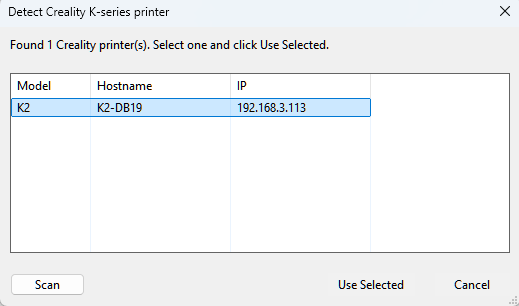
| **Discovery dialog** — `Browse...` flow on a `host_type=crealityprint`
printer. Click → ~5–10 s LAN scan → K2 found with model + hostname + IP.
|
| 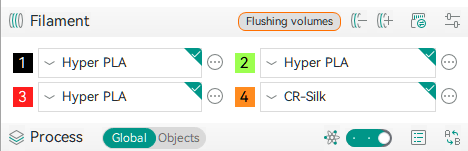
| **CFS filament sync** — Sidebar after clicking the sync icon: 4 slots
populate with the real loaded CFS spools (3× Hyper PLA + 1× CR-Silk). |
| 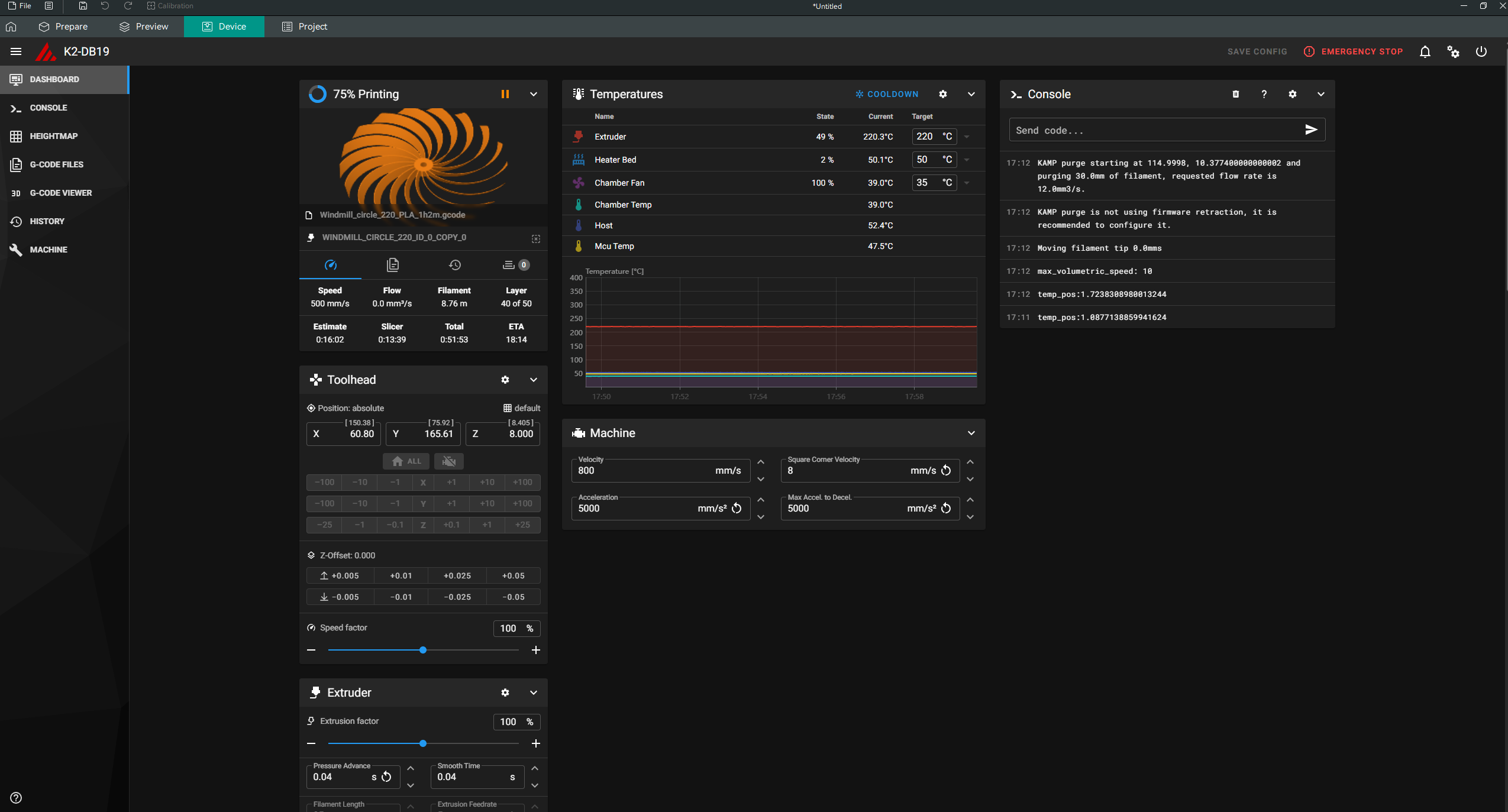
| **Device tab** — Mainsail loaded into the embedded WebView for
`host_type=crealityprint`, mid-print state visible. |
## What's added
### LAN discovery
- **`deps_src/mdns/`** — vendors
[mjansson/mdns](https://github.com/mjansson/mdns) (public domain) plus
Creality's `cxmdns` C++ wrapper from CrealityPrint v7.1.1 (AGPL-3.0,
compatible with OrcaSlicer's AGPL-3.0). Attribution in
`deps_src/mdns/NOTICE.md`.
- **`Utils/CrealityHostDiscovery.{hpp,cpp}`** — synchronous DNS-SD scan
+ per-host `GET /info` probe. Maps model codes `F008` / `F012` / `F021`
→ K2 Plus / K2 Pro / K2.
- **`GUI/CrealityDiscoveryDialog.{hpp,cpp}`** — modal `wxDialog` showing
Model / Hostname / IP for each discovered host.
- **`src/slic3r/CMakeLists.txt`** — adds `Iphlpapi.lib` and `Ws2_32.lib`
to `libslic3r_gui`'s MSVC link line (needed by `GetAdaptersAddresses` +
Winsock2 calls in vendored `mdns.c`).
### CFS filament sync
- **`Utils/CrealityPrintAgent.{hpp,cpp}`** — inherits
`MoonrakerPrinterAgent`, overrides `fetch_filament_info()` to query the
K-series WS protocol on `:9999`, build `AmsTrayData`, and call inherited
`build_ams_payload()`. No printer-specific code lives outside the agent.
- K2 Plus slot-state parser handles the three documented slot states
(`0` empty / `1` manually entered / `2` RFID-tagged) per [DaviBe92's
reverse-engineering docs](https://github.com/DaviBe92/k2-websocket-re).
### K-series filament profiles
- ~110 profile JSONs under `resources/profiles/Creality/filament/`
covering K2 / K2 Plus / K2 Pro × 0.2 / 0.4 / 0.6 / 0.8 nozzle combos ×
CR-PLA / CR-PETG / CR-ABS / CR-Silk / CR-TPU / CR-Nylon / CR-Wood /
Hyper PLA / Hyper PETG-GF / Hyper PLA-CF / etc.
- Imported from CrealityPrint v7.1.0; normalised to OrcaSlicer profile
conventions (tabs not spaces, no `{if !multicolor_method}` wrappers,
`filament_vendor: ["Creality"]` on Creality Generic profiles).
## Tester confirmations on the v4 test build
| Printer | Firmware | Result | Reporter |
|---|---|---|---|
| K2 Pro | v1.1.5.5 / CFS v1.4.2 | ✅ LAN discovery on #13752 test build
|
[@Requiem-MH](https://github.com/OrcaSlicer/OrcaSlicer/pull/13752#issuecomment-4495235225)
|
| K2 Pro | v1.1.5.5 / CFS v1.4.2 | ✅ CFS sync across 1-CFS, 2-CFS,
partial, full configurations |
[@Requiem-MH](https://github.com/OrcaSlicer/OrcaSlicer/pull/13744#issuecomment-4495230061)
|
| K2 Plus | v1.1.5.2 / CFS v1.2.2 | ✅ Slot-state fix resolves the
partial-sync regression |
[@DaviBe92](https://github.com/OrcaSlicer/OrcaSlicer/pull/13744#issuecomment-4499425852)
|
| K2 Plus | v1.1.5.5 / CFS v1.4.2 | ✅ All slots syncing correctly after
fix |
[@swilsonnc](https://github.com/OrcaSlicer/OrcaSlicer/pull/13744#issuecomment-4503273127)
|
| K2 Plus | (Reddit u/TrainAss) | ✅ Both PLA + PETG slots populated
correctly |
[@TrainAss](https://github.com/OrcaSlicer/OrcaSlicer/pull/13744#issuecomment-4503401664)
|
| K1C | (latest stock) | ✅ `boxsInfo` payload format compatible (4 slots
of generic PETG) |
[@JoveYu](https://github.com/OrcaSlicer/OrcaSlicer/pull/13744#issuecomment-4519036448)
|
## Known follow-ups (out of scope)
- **Snapmaker U1 regression**
([@TrainAss](https://github.com/OrcaSlicer/OrcaSlicer/pull/13744#issuecomment-4529350262)):
the v3 build also happened to sync filament from his U1; v4 regressed
this. The refactor only touches `htCrealityPrint`-gated code so this is
likely incidental — needs his config + logs to diagnose. Will follow up
in a separate issue once this lands.
- **Native Device tab for K-series**: deferred. Current Mainsail WebView
shim covers the common case.
- **#13581 (@hamham999) profile overlap**: confirmed minimal code
conflict (zero), profile-file overlap of ~204 files. Whichever PR lands
second rebases off the other.
## Test plan
- [x] Linux build clean on commit `<UPDATED AFTER BUILD>` (LXC 104, GCC
12, cmake)
- [x] MSVC link clean (manual VS 2026 / MSVC 14.51 build)
- [x] End-to-end on real hardware: K2 Combo, K2 Pro, K2 Plus, K1C
- [x] `host_type ≠ htCrealityPrint` paths unchanged — Bonjour fires for
OctoPrint, Flashforge picker fires for Flashforge, Moonraker / Qidi /
Snapmaker agents unchanged
- [x] Profile-validation CI green (was a separate Elegoo test-fixture
failure on main, not introduced by this PR)
Signed-off-by: Igor Mammedov <niallain@gmail.com>
Co-authored-by: Igor Mammedov <niallain@gmail.com>
Co-authored-by: grant0013 <grant@harktech.co.uk>
Co-authored-by: SoftFever <softfeverever@gmail.com>
Co-authored-by: hamham999 <hamham999@users.noreply.github.com>
Co-authored-by: Alys Andreollo <3528187+alysandreollo@users.noreply.github.com>
* Update the stealth mode description to reflect the current code changes in 2.4.

* disable HMS if bambu network plugin is not installed or in stealth mode

* fix build err

* add hide_login_side_panel to control whether to show login panel in home page
Wire the existing disassociate_url path into the Associate-tab
checkbox so users can revert prusaslicer/bambustudio/cura
registrations they previously enabled.
After pulling the latest presets from the cloud, changed values such as Layer height kept showing the old value until the user switched tabs. Refresh the active settings tab on sync so updates appear immediately.
GridCellSupportEditor::DoActivate dereferenced
grid->GetSelectedBlocks().begin() without checking against end(). In
wxWidgets 3.1.5 that range always contained at least one block; in 3.3.2
it is empty after the user deselects, and the dereference crashes inside
wxGridBlockCoords::GetLeftCol().

Fall back to the (row, col) that triggered activation when the selection
is empty, so the existing single-cell branch handles it. While here,
drop a dead local_table cast that was never read.
Use glBlendFuncSeparate in GLTexture::render_sub_texture so destination
  alpha stays at 1.0. The Wayland compositor honors framebuffer alpha for     window compositing; the previous straight-alpha blend reduced dst alpha
  at anti-aliased icon edges, making them semi-transparent against the
  desktop. RGB blending is unchanged, so X11/Windows/macOS are unaffected.
Delay opening the object-list filament dropdown on wxGTK until the editor
  window is mapped, avoiding popup creation without a valid native toplevel.
  Also set the GTK transient parent for dropdown popups created from data-view
  cell editors.
load_selections() and update_selections() size the parallel project_config
arrays (filament_colour, filament_colour_type, filament_map) off
filament_presets.size(). When the saved list is shorter than the printer's
nozzle count — never-used printer, hand-trimmed conf, or fewer filament_NN
entries than nozzles — the loaded colors get truncated and the sidebar
starts up one combo short.
fix: eliminate UI freeze during cloud preset sync on startup
  Move synchronous HTTP calls off the main thread in
  GUI_App::start_sync_user_preset():

  - Call scan_orphaned_info_files() and process_delete_presets() in
    the background sync thread instead of the UI thread, so their
    HTTP DELETE calls don't block startup.
  - Call reload_settings() directly from the background thread
    instead of via CallAfter, so get_user_presets() (HTTP GET) and
    load/save_user_presets (file I/O) run off the main thread.
  - Guard update_side_preset_ui() and app_config->save() with
    is_main_thread_active() / CallAfter so they're safe when called
    from a worker thread.
  - Simplifiy finishFn lambdas: the progress-dialog case only
    destroys the dialog; the no-dialog case is a no-op.
On macOS, PopupWindow::OnMouseEvent2 synthesizes a wxEVT_ENTER_WINDOW on
`this` whenever the hovered target transitions from a child back to the
popup itself. wxPopupTransientWindow's OnIdle re-acquires mouse capture
once the cursor leaves the popup, so the next MOTION (with the cursor
already outside) hits OnMouseEvent2 with no child and synthesizes ENTER
on the popup — which would otherwise cancel the dismissal timer started
by OnLeaveWindow. Verify the cursor is actually inside before resetting.
 SoftFever


