 dc5897d7b5
* Update eigen from v3.3.7 to v5.0.1. This updates eigen from v3.3.7 released on December 11, 2018-12-11 to v5.0.1 released on 2025-11-11. There have be a large number of bug-fixes, optimizations, and improvements between these releases. See the details at; https://gitlab.com/libeigen/eigen/-/releases It retains the previous custom minimal `CMakeLists.txt`, and adds a README-OrcaSlicer.md that explains what version and parts of the upstream eigen release have been included, and where the full release can be found. * Update libigl from v2.0.0 (or older) to v2.6.0. This updates libigl from what was probably v2.0.0 released on 2018-10-16 to v2.6.0 released on 2025-05-15. It's possible the old version was even older than that but there is no version indicators in the code and I ran out of patience identifying missing changes and only went back as far as v2.0.0. There have been a large number of bug-fixes, optimizations, and improvements between these versions. See the following for details; https://github.com/libigl/libigl/releases I retained the minimal custom `CMakeLists.txt`, added `README.md` from the libigl distribution which identifies the version, and added a README-OrcaSlicer.md that details the version and parts that have been included. * Update libslic3r for libigl v2.6.0 changes. This updates libslic3r for all changes moving to eigen v5.0.1 and libigl v2.6.0. Despite the large number of updates to both dependencies, no changes were required for the eigen update, and only one change was required for the libigl update. For libigl, `igl::Hit` was changed to a template taking the Scalar type to use. Previously it was hard-coded to `float`, so to minimize possible impact I've updated all places it is used from `igl::Hit` to `igl::Hit<float>`. * Add compiler option `-DNOMINMAX` for libigl with MSVC. MSVC by default defines `min(()` and `max()` macros that break `std::numeric_limits<>::max()`. The upstream cmake that we don't include adds `-DNOMINMAX` for the libigl module when compiling with MSVC, so we need to add the same thing here. * Fix src/libslic3r/TriangleMeshDeal.cpp for the unmodified upstream libigl. This fixes `TriangleMeshDeal.cpp` to work with the unmodified upstream libigl v2.6.0. loop.{h,cpp} implementation. This file and feature was added in PR "BBS Port: Mesh Subdivision" (#12150) which included changes to `loop.{h,cpp}` in the old version of libigl. This PR avoids modifying the included dependencies, and uses the updated upstream versions of those files without any modifications, which requires fixing TriangleMeshDeal.cpp to work with them. In particular, the modifications made to `loop.{h,cpp}` included changing the return type from void to bool, adding additional validation checking of the input meshes, and returning false if they failed validation. These added checks looked unnecessary and would only have caught problems if the input mesh was very corrupt. To make `TriangleMeshDeal.cpp` work without this built-in checking functionality, I removed checking/handling of any `false` return value. There was also a hell of a lot of redundant copying and casting back and forth between float and double, so I cleaned that up. The input and output meshs use floats for the vertexes, and there would be no accuracy benefits from casting to and from doubles for the simple weighted average operations done by igl::loop(). So this just uses `Eigen:Map` to use the original input mesh vertex data directly without requiring any copy or casting. * Move eigen from included `deps_src` to externaly fetched `deps`. This copys what PrusaSlicer did and moved it from an included dependency under `deps_src` to an externaly fetched dependency under `deps`. This requires updating some `CMakeList.txt` configs and removing the old and obsolete `cmake/modules/FindEigen3.cmake`. The details of when this was done in PrusaSlicer and the followup fixes are at; *21116995d7* https://github.com/prusa3d/PrusaSlicer/issues/13608 * https://github.com/prusa3d/PrusaSlicer/pull/13609 *e3c277b9eeFor some reason I don't fully understand this also required fixing `src/slic3r/GUI/GUI_App.cpp` by adding `#include <boost/nowide/cstdio.hpp>` to fix an `error: ‘remove’ is not a member of ‘boost::nowide'`. The main thing I don't understand is how it worked before. Note that this include is in the PrusaSlicer version of this file, but it also significantly deviates from what is currently in OrcaSlicer in many other ways. * Whups... I missed adding the deps/Eigen/Eigen.cmake file... * Tidy some whitespace indenting in CMakeLists.txt. * Ugh... tabs indenting needing fixes. * Change the include order of deps/Eigen. It turns out that although Boost includes some references to Eigen, Eigen also includes some references to Boost for supporting some of it's additional numeric types. I don't think it matters much since we are not using these features, but I think technically its more correct to say Eigen depends on Boost than the other way around, so I've re-ordered them. * Add source for Eigen 5.0.1 download to flatpak yml config. * Add explicit `DEPENDS dep_Boost to deps/Eigen. I missed this before. This ensures we don't rely on include orders to make sure Boost is installed before we configure Eigen. * Add `DEPENDS dep_Boost dep_GMP dep_MPFR` to deps/Eigen. It turns out Eigen can also use GMP and MPFR for multi-precision and multi-precision-rounded numeric types if they are available. Again, I don't think we are using these so it doesn't really matter, but it is technically correct and ensures they are there if we ever do need them. * Fix deps DEPENDENCY ordering for GMP, MPFR, Eigen, and CGAL. I think this is finally correct. Apparently CGAL also optionally depends on Eigen, so the correct dependency order from lowest to highest is GMP, MPFR, Eigen, and CGAL. --------- Co-authored-by: Donovan Baarda <dbaarda@google.com> Co-authored-by: Noisyfox <timemanager.rick@gmail.com>


OrcaSlicer: an open source Next-Gen Slicing Software for Precision 3D Prints.
Optimize your prints with ultra-fast slicing, intelligent support generation, and seamless printer compatibility—engineered for perfection.
Official links and community
Official Website:
Github Repository:

Follow us:

Join our Discord community:

|
⚠️ CAUTION: Several clickbait and malicious websites, such as orca-slicer[.]com and orcaslicer[.]net, are pretending to be the official OrcaSlicer site. These sites may redirect you to dangerous downloads or contain misleading information. Our only official website is www.orcaslicer.com. If you come across any of these in search results, please report them as unsafe or phishing to help keep the community secure with: - Google Safe Browsing - Microsoft Security Intelligence - IPThreat |
Main features
- Advanced Calibration Tools
Comprehensive suite: temperature towers, flow rate, retraction & more for optimal performance. - Precise Wall and Seam Control
Adjust outer wall spacing and apply scarf seams to enhance print accuracy. - Sandwich Mode and Polyholes Support
Use varied infill patterns and accurate hole shapes for improved clarity. - Overhang and Support Optimization
Modify geometry for printable overhangs with precise support placement. - Granular Controls and Customization
Fine-tune print speed, layer height, pressure, and temperature with precision. - Network Printer Support
Seamless integration with Klipper, PrusaLink, and OctoPrint for remote control. - Mouse Ear Brims & Adaptive Bed Mesh
Automatic brims and adaptive mesh calibration ensure consistent adhesion. - User-Friendly Interface
Intuitive drag-and-drop design with pre-made profiles for popular printers. - Open-Source & Community Driven
Regular updates fueled by continuous community contributions. - Wide Printer Compatibility
Supports a broad range of printers: Bambu Lab, Prusa, Creality, Voron, and more. - Additional features can be found in the change notes.
Wiki
The wiki aims to provide a detailed explanation of the slicer settings, including how to maximize their use and how to calibrate and set up your printer.
Download
Stable Release
📥 Download the Latest Stable Release
Visit our GitHub Releases page for the latest stable version of OrcaSlicer, recommended for most users.
Nightly Builds
🌙 Download the Latest Nightly Build
Explore the latest developments in OrcaSlicer with our nightly builds. Feedback on these versions is highly appreciated.
How to install
Windows
Download the Windows Installer exe for your preferred version from the releases page.
-
For convenience there is also a portable build available.
Troubleshooting
- If you have troubles to run the build, you might need to install following runtimes:
- MicrosoftEdgeWebView2RuntimeInstallerX64
- vcredist2019_x64
- Alternative Download Link Hosted by Microsoft
- This file may already be available on your computer if you've installed visual studio. Check the following location:
%VCINSTALLDIR%Redist\MSVC\v142
Windows Package Manager
winget install --id=SoftFever.OrcaSlicer -e
Mac
-
Download the DMG for your computer:
arm64version for Apple Silicon andx86_64for Intel CPU. -
Drag OrcaSlicer.app to Application folder.
-
If you want to run a build from a PR, you also need to follow the instructions below:
Quarantine
-
Option 1 (You only need to do this once. After that the app can be opened normally.):
- Step 1: Hold cmd and right click the app, from the context menu choose Open.
- Step 2: A warning window will pop up, click Open
-
Option 2: Execute this command in terminal:
xattr -dr com.apple.quarantine /Applications/OrcaSlicer.app -
Option 3:
- Step 1: open the app, a warning window will pop up
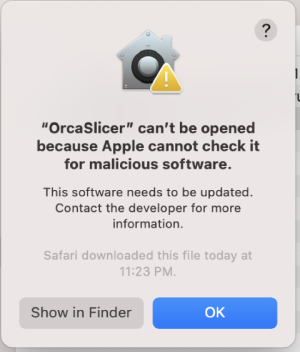
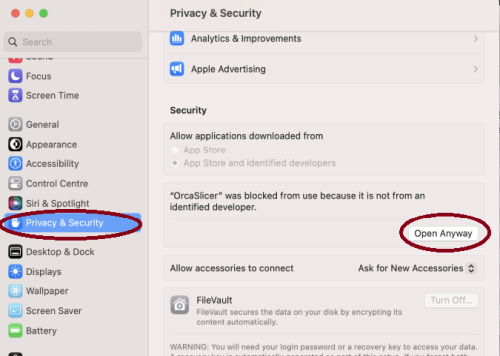
- Step 2: in
System Settings->Privacy & Security, clickOpen Anyway:
- Step 1: open the app, a warning window will pop up
-


Linux
Flathub (Recommended)
OrcaSlicer is available through FlatHub:

Install from the command line:
flatpak install flathub com.orcaslicer.OrcaSlicer
flatpak run com.orcaslicer.OrcaSlicer
It can also be installed through graphical software managers (KDE Discover, GNOME Software, etc.) when Flathub is enabled. Search for OrcaSlicer in your software center.
AppImage
-
Download App image from the releases page.
-
Double click the downloaded file to run it.
-
If you run into trouble executing it, try this command in the terminal:
chmod +x /path_to_appimage/OrcaSlicer_Linux.AppImage
How to Compile
All updated build instructions for Windows, macOS, and Linux are now available on the official OrcaSlicer Wiki - How to build page.
Please refer to the wiki to ensure you're following the latest and most accurate steps for your platform.
Klipper Note
If you're running Klipper, it's recommended to add the following configuration to your printer.cfg file.
# Enable object exclusion
[exclude_object]

# Enable arcs support
[gcode_arcs]
resolution: 0.1
Supports
OrcaSlicer is an open-source project and I'm deeply grateful to all my sponsors and backers.
Their generous support enables me to purchase filaments and other essential 3D printing materials for the project.
Thank you! :)
Sponsors:

|

|
Backers:
Ko-fi supporters ☕: Backers list
Support me



Some Background
Open-source slicing has always been built on a tradition of collaboration and attribution. Slic3r, created by Alessandro Ranellucci and the RepRap community, laid the foundation. PrusaSlicer by Prusa Research built on Slic3r and acknowledged that heritage. Bambu Studio in turn forked from PrusaSlicer, and SuperSlicer by @supermerill extended PrusaSlicer with community-driven enhancements. Each project carried the work of its predecessors forward, crediting those who came before.
OrcaSlicer began in that same spirit, drawing from BambuStudio, PrusaSlicer, and ideas inspired by CuraSlicer and SuperSlicer. But it has since grown far beyond its origins. Through relentless innovation — introducing advanced calibration tools, precise wall and seam control, tree supports, adaptive slicing, and hundreds of other features — OrcaSlicer has become the most widely used and actively developed open-source slicer in the 3D printing community. Many of its innovations have been adopted by other slicers, making it a driving force for the entire industry.
The OrcaSlicer logo was designed by community member Justin Levine (@freejstnalxndr).
License
- OrcaSlicer is licensed under the GNU Affero General Public License, version 3.
- The GNU Affero General Public License, version 3 ensures that if you use any part of this software in any way (even behind a web server), your software must be released under the same license.
- OrcaSlicer includes a pressure advance calibration pattern test adapted from Andrew Ellis' generator, which is licensed under GNU General Public License, version 3. Ellis' generator is itself adapted from a generator developed by Sineos for Marlin, which is licensed under GNU General Public License, version 3.
- The Bambu networking plugin is based on non-free libraries from BambuLab. It is optional to the OrcaSlicer and provides extended functionalities for Bambulab printer users.