 Tim Schneiderandyw4z
b6bb1b92c9
Tim Schneiderandyw4z
b6bb1b92c9
* Add Meltingplot vendor profiles (CHX 350 + MBL series)

Adds the Meltingplot vendor bundle with 5 printer models:
- CHX 350 (880x422x943, RepRapFirmware/Duet)
- MBL 133/136/308/480 (RepRapFirmware/Duet)

Each model ships 0.4/0.6/0.8/1.0/1.2 nozzle variants. Layer height
presets span 40-60% of the nozzle diameter and deliberately avoid
heights that divide the Z screw lead evenly (CHX: 1204 ball screw,
4 mm lead; MBL: TR4x2 trapezoidal screw, 8 mm lead) so periodic
screw error does not repeat as banding.

All printers use 2.85 mm filament, so the bundle carries its own
filament library (PLA, StoneFil, ABS, TitanX, ASA, PETG, PA6 CF HT,
STYX 12, PP 9-2, PET-CF15, Extrudr PLA NX2 Matt, Igus iglidur J260)
with the 2.85 mm diameter pinned once in the vendor-local
fdm_filament_common base.

Machine limits mirror the printers' firmware configuration; machine
limit emission is disabled so the values only feed the time estimator.

* Add per-nozzle volumetric flow limits and nozzle size in filename

Cap filament volumetric speed per nozzle (0.4: 14, 0.6: 20, 0.8: 26,
1.0: 30, 1.2: 40 mm3/s). Filaments whose limit exceeds a nozzle's
capability get a nozzle-scoped child profile that only lowers
filament_max_volumetric_speed; filament_id is inherited so all nozzle
variants remain the same material.

Also include layer height and nozzle diameter in the g-code filename.

* Set CHX 350 machine time cost to 5 EUR/h

* Inherit Meltingplot filaments from OrcaFilamentLibrary generics

Per the profile creation guide, vendor filament profiles now inherit
from Generic * @System instead of vendor-local fdm_filament_* copies.
Each profile carries only Meltingplot-specific deviations plus the
2.85 mm filament diameter; the seven local fdm_filament_* base files
are removed.

Deliberate pins where the library default would change tuned behavior:
- PLA/ABS/TitanX keep filament_max_volumetric_speed 20 (0.6 nozzle cap)
- ABS/PET-CF15 keep close_fan_the_first_x_layers 1
- STYX 12 sets required_nozzle_HRC 0 (unfilled PA12, density 1.02)

* Remove Meltingplot StoneFil filament profile

* Meltingplot ABS: use library fan settings

* Meltingplot TitanX/ABS: use library fan and nozzle temperature settings

* Remove STYX 12, PP 9-2 and Igus iglidur J260 filament profiles

* Meltingplot ASA: use library fan_max_speed

* Derive per-nozzle volumetric speed caps from physical limit formula

Caps now follow V = 34*d * m / S: the 34*d limit line calibrated on
Micro Swiss Volcano plated copper at 2.85 mm, material factor m from
the OrcaFilamentLibrary generic ratios (PLA/ABS/ASA 1.0, PETG 10/12,
PETG-CF 11.5/12, PA-CF 8/12, PLA Matte 11/12), safety factor S = 1.25
covering batch/moisture/wear/diameter tolerances.

Each material base now serves the 1.2 nozzle at its maximum cap;
children @0.4-@1.0 lower the cap per nozzle. Machine variant
default_filament_profile entries point at the matching preset.

* Scale slow_down_layer_time per nozzle from bead cross-section

Minimum layer time follows the derived cooling rule: heat per layer
scales with bead cross-section (layer height x line width), so the
0.8-nozzle-tuned values are scaled by q(d)/q(0.8) using each nozzle's
standard preset geometry. Bases carry the 1.2 value, children @0.4-@1.0
their nozzle-specific value.

* Meltingplot: lift Z above the print before the end macro

Add a G90 / G1 Z{min(max_layer_z + 5, printable_height)} F600 move at the
start of machine_end_gcode, before M98 print_end shuts the printer down and
parks it. Besides clearing the part, the explicit Z coordinate lets the Duet
file-info parser pick up the object height.

* Meltingplot: cap default layer height at 40% of outer wall width

A 45 deg slope shifts each bead outward by exactly one layer height. With
the Slic3r bead model (rectangle (w-h) x h plus half-circles of diameter h)
the flat contact band to the layer below is w - 2h, so the maximum
self-supporting angle is atan((w-h)/h). Support cannot compensate: the
stair tread at 45 deg is only h wide, far below one support line width, so
no support line ever fits underneath a single step.

All ten machine variants defaulted to h/w = 0.455..0.524, i.e. at or past
the h/w = 0.5 point where the flat contact vanishes. The 0.8 nozzle default
(0.44 mm at w = 0.84) reached atan(0.4/0.44) = 42.3 deg and failed on 45 deg
slopes even with support.

Default presets now satisfy h <= 0.40 * outer_wall_line_width, which leaves
one third of the bead's flat underside in contact at 45 deg and puts the
geometric limit at 56.3 deg. To keep the defaults on sensible ladder rungs,
outer wall width is widened where it was the binding constraint:
chx_small 110 -> 115%, chx_large 105 -> 110%, mbl_04 105 -> 115%.

Ladders are unchanged; the thicker rungs stay available for parts without
steep overhangs.

* Meltingplot PLA: raise slow_down_layer_time by calibration factor 1.5

Print feedback on CHX 350 with a 0.8 nozzle at 0.44 mm layer height showed
curling at the retraction points with the derived value of 25 s. There is no
cooling headroom left to trade: fdm_filament_pla pins fan_min_speed =
fan_max_speed = 100, and additional_cooling_fan_speed is inert because no
Meltingplot machine enables auxiliary_fan. Minimum layer time is the only
remaining lever; 35 s prints cleanly at that geometry.

The cross-section rule only fixes the ratios between nozzle sizes, so this
is a calibration of the PLA anchor itself: both PLA ladders are scaled by
1.5 (Extrudr 9/20/38/56/83 s, Meltingplot PLA 8/17/30/45/66 s for
0.4/0.6/0.8/1.0/1.2). The Extrudr base fan_cooling_layer_time goes 60 -> 100
so the 1.2-nozzle value stays below it.

Other materials are left unchanged - only the PLA anchor has a real
counter-example so far.

* Meltingplot: drop layer heights that cannot print 45 degree walls

A preset whose layer height exceeds ~45% of the outer wall line width has
less than ~6 degrees of reserve on a 45 degree wall (max self-supporting
angle atan((w-h)/h)), and support cannot compensate because the 45 degree
stair tread is only h wide - far below one support line. Those presets are
not usable in practice, so shipping them only invites failed prints.

Removes the 22 rungs above h/w = 0.45 and prunes them from the vendor
index. What remains per nozzle (default first):

  CHX 350   0.4: 0.18 | 0.6: 0.24 0.28 | 0.8: 0.32 0.36
            1.0: 0.44 0.48 | 1.2: 0.48 0.56
  MBL       0.4: 0.18 | 0.6: 0.24 0.28 | 0.8: 0.36 0.34
            1.0: 0.44 0.48 | 1.2: 0.48 0.56

The 0.4 nozzle keeps a single rung: 0.20 mm would qualify (h/w = 0.435) but
divides both screw leads evenly (4/0.20, 8/0.20) and stays excluded by the
Z-artifact rule, and 0.22 is already at 0.478.

Also corrects the MBL 0.8 default to 0.36 mm, which at w = 0.92 sits at
h/w = 0.391 and therefore still satisfies the stricter 40% default rule.

* Meltingplot: require 5 degrees of reserve on 45 degree walls

Replaces the two separate thresholds (h <= 0.40 * outer wall width for
defaults, 0.45 for ladder rungs) with a single requirement stated on the
design constraint itself: every shipped preset must reach

  a_max = atan((w - h) / h) >= 50 deg

i.e. 5 degrees of reserve on a 45 degree wall, equivalent to
h <= 0.456 * outer_wall_line_width. The default is simply the thickest rung
that passes.

The 11 degrees the 40% rule produced were more margin than the failure mode
warrants, and cost throughput for no return. For calibration: across 940
machine defaults from 60 vendor bundles in this repo, the median reserve is
+1.8 deg, 71% ship less than 5 deg, and 8% cannot geometrically produce a
45 deg wall at all.

Adds the rungs the relaxed threshold makes available - 0.30 (0.6 nozzle,
both series) and 0.38 (0.8 nozzle, both series) - and restores the 0.30 mm
MBL preset removed in 5b4862b3 with its original setting_id. 0.20 mm on the
0.4 nozzle and 0.50 mm on the 1.0 nozzle would also qualify but stay
excluded because they divide both screw leads evenly.

Defaults are now (0.4/0.6/0.8/1.0/1.2) 0.18/0.30/0.38/0.48/0.56 for both
series, at 50.2 to 57.3 deg. The 1.2 nozzle deliberately keeps 0.56 rather
than the 0.60 the rule would allow: solidification time scales with h^2 and
bead weight with h*w, so the largest nozzle is the one that should not sit
on the minimum.

* Meltingplot: disable precise wall by default

Precise wall was inheriting OrcaSlicer's global default of true. Disable it
bundle-wide in the vendor process root so it applies to CHX 350 and all MBL
models. Note it was already ignored on the CHX small-nozzle branch, which
uses the inner-outer-inner wall sequence.

* Meltingplot CHX: raise max extruding acceleration to 6000

The 4000 limit silently clamped the profiles' 6000 values for default and
inner wall acceleration, since GCodeWriter caps print acceleration against
machine_max_acceleration_extruding regardless of emit_machine_limits_to_gcode.
Raising it to 6000 matches the X/Y limits so the configured values are emitted
as-is. The firmware's own M201 still governs what is actually driven.

* Meltingplot PA6 CF HT: raise part cooling floor to 40%

Sharp 90 degree corners were washing out layer by layer while straight walls
and overhangs printed cleanly. Overhangs are fine because overhang_fan_speed
forces 100% regardless of layer time; everything else fell back to
fan_min_speed, since at the layer times seen in practice neither branch of the
layer-time fan interpolation applies.

Raise fan_min_speed to 40% and set reduce_fan_stop_start_freq so that floor is
actually applied instead of dropping to zero. Also lower the auxiliary fan to
40% and raise the overhang cooling threshold to 95%, matching the values
validated on the print.

* Meltingplot: re-mint filament ids with orca_id_tool

Upstream now requires every filament_id to be a minted "OF" id derived
from the (filament_vendor, filament_type, name) triple and recorded in
scripts/filament_id_snapshot.json. The hand-made ids this bundle shipped
with (MPFPLA0, EXTNX2M, ...) were rejected by orca_extra_profile_check.

Regenerate them with "orca_id_tool.py --generate --vendor Meltingplot"
and record the result with --update-snapshot. No setting_id changed, and
the ids were never released, so no existing project file refers to them.

* Meltingplot: normalize bundle for updated profile checks

Drop obsolete keys (silent_mode, adaptive_layer_height, tree_support_with_infill) and rebuild the vendor index in canonical order, as orca_profile_tool.py normalize / update-index write them.

* Meltingplot: list per-nozzle filaments in default_materials

The unsuffixed filament presets only cover the 1.2 mm variants, so the 0.4-1.0 mm printer presets had no compatible entry in their model's default_materials. The validator's check_printer_default_materials rejects that, and load_installed_filaments would auto-install no filament for those variants on first run. Name the @0.4/0.6/0.8/1.0 nozzle presets alongside the base ones for PLA, PETG, ABS and ASA.

---------

Co-authored-by: yw4z <ywsyildiz@gmail.com>


OrcaSlicer: an open source Next-Gen Slicing Software for Precision 3D Prints.
Optimize your prints with ultra-fast slicing, intelligent support generation, and seamless printer compatibility—engineered for perfection.
Official links and community
Official Website:
Github Repository:

Follow us:


Join our Discord community:

|
⚠️ CAUTION: Several clickbait and malicious websites, such as orca-slicer[.]com and orcaslicer[.]net, are pretending to be the official OrcaSlicer site. These sites may redirect you to dangerous downloads or contain misleading information. Our only official website is www.orcaslicer.com. If you come across any of these in search results, please report them as unsafe or phishing to help keep the community secure with: - Google Safe Browsing - Microsoft Security Intelligence - IPThreat |
Main features
- Advanced Calibration Tools
Comprehensive suite: temperature towers, flow rate, retraction & more for optimal performance. - Precise Wall and Seam Control
Adjust outer wall spacing and apply scarf seams to enhance print accuracy. - Sandwich Mode and Polyholes Support
Use varied infill patterns and accurate hole shapes for improved clarity. - Overhang and Support Optimization
Modify geometry for printable overhangs with precise support placement. - Granular Controls and Customization
Fine-tune print speed, layer height, pressure, and temperature with precision. - Network Printer Support
Seamless integration with Klipper, PrusaLink, and OctoPrint for remote control. - Mouse Ear Brims & Adaptive Bed Mesh
Automatic brims and adaptive mesh calibration ensure consistent adhesion. - User-Friendly Interface
Intuitive drag-and-drop design with pre-made profiles for popular printers. - Open-Source & Community Driven
Regular updates fueled by continuous community contributions. - Wide Printer Compatibility
Supports a broad range of printers: Bambu Lab, Prusa, Creality, Voron, and more. - Additional features can be found in the change notes.
Wiki
The wiki aims to provide a detailed explanation of the slicer settings, including how to maximize their use and how to calibrate and set up your printer.
Download
Stable Release
📥 Download the Latest Stable Release
Visit our GitHub Releases page for the latest stable version of OrcaSlicer, recommended for most users.
Nightly Builds
🌙 Download the Latest Nightly Build
Explore the latest developments in OrcaSlicer with our nightly builds. Feedback on these versions is highly appreciated.
Belt Printer Builds
The nightly release ships two parallel builds: the standard build and a belt-printer build. Both are attached to the same release — tell them apart by the filename suffix:
- Standard — no suffix (e.g.
OrcaSlicer_Windows_Installer_x64_nightly.exe) - Belt —
_beltsuffix (e.g.OrcaSlicer_Windows_Installer_x64_nightly_belt.exe)
The _belt builds add experimental support for belt / conveyor (infinite-Z) printers, where the model is sliced against a tilted belt surface instead of a flat horizontal bed. They include ready-to-use belt printer profiles, the full belt slicing pipeline (mesh rotation and G-code transforms), belt-aware support generation, and a tilted-bed preview.
⚠️ Belt printer support is under active development and is not yet merged into
main— it currently ships only in these parallel_beltbuilds, produced from thebelt-printerbranch. See tracking PR #14394 and the original documentation in #12998.
How to install
Windows
Download the Windows Installer exe for your preferred version from the releases page. Both x64 and arm64 installers are published — pick the one matching your CPU.
-
For convenience there is also a portable build available.
Troubleshooting
- If you have troubles to run the build, you might need to install following runtimes:
- MicrosoftEdgeWebView2RuntimeInstallerX64
- vcredist2019_x64
- Alternative Download Link Hosted by Microsoft
- This file may already be available on your computer if you've installed visual studio. Check the following location:
%VCINSTALLDIR%Redist\MSVC\v142
Microsoft Store
Install from the Microsoft Store when you prefer a Store-signed package (helps on Windows 11 Smart App Control).
Windows Package Manager
winget install --id=SoftFever.OrcaSlicer -e
Mac
-
Download the universal DMG, which runs on both Apple Silicon and Intel Macs.
-
Drag OrcaSlicer.app to Application folder.
-
If you want to run a build from a PR, you also need to follow the instructions below:
Quarantine
-
Option 1 (You only need to do this once. After that the app can be opened normally.):
- Step 1: Hold cmd and right click the app, from the context menu choose Open.
- Step 2: A warning window will pop up, click Open
-
Option 2: Execute this command in terminal:
xattr -dr com.apple.quarantine /Applications/OrcaSlicer.app -
Option 3:
- Step 1: open the app, a warning window will pop up
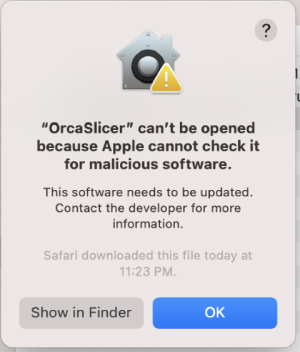
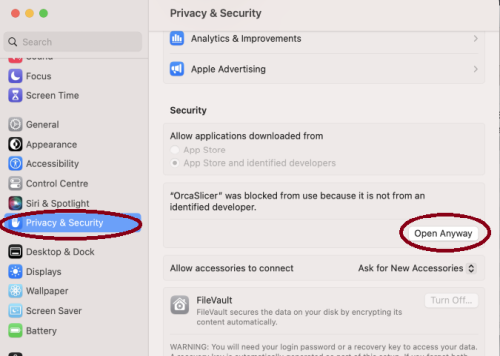
- Step 2: in
System Settings->Privacy & Security, clickOpen Anyway:
- Step 1: open the app, a warning window will pop up
-


Homebrew Cask
brew install --cask orcaslicer
The Homebrew cask installs the official macOS DMG from GitHub Releases.
Linux
Flathub (Recommended)
OrcaSlicer is available through FlatHub:

Install from the command line:
flatpak install flathub com.orcaslicer.OrcaSlicer
flatpak run com.orcaslicer.OrcaSlicer
It can also be installed through graphical software managers (KDE Discover, GNOME Software, etc.) when Flathub is enabled. Search for OrcaSlicer in your software center.
AppImage
AppImages are published for both x86_64 and aarch64 (ARM64). Pick the file matching your CPU — the ARM64 build has aarch64 in its name (e.g. OrcaSlicer_Linux_AppImage_Ubuntu2404_aarch64_*.AppImage).
-
Download App image from the releases page.
-
Double click the downloaded file to run it.
-
If you run into trouble executing it, try this command in the terminal:
chmod +x /path_to_appimage/OrcaSlicer_Linux.AppImage
How to Compile
All updated build instructions for Windows, macOS, and Linux are now available on the official OrcaSlicer Wiki - How to build page.
Please refer to the wiki to ensure you're following the latest and most accurate steps for your platform.
Klipper Note
If you're running Klipper, it's recommended to add the following configuration to your printer.cfg file.
# Enable object exclusion
[exclude_object]

# Enable arcs support
[gcode_arcs]
resolution: 0.1
Supports
OrcaSlicer is an open-source project, and we're deeply grateful to all our sponsors and backers.
Their generous support helps fund filaments and other essential 3D printing materials for the project.
Thank you! :)
Sponsors

|

|
Backers:
Ko-fi supporters ☕: Backers list
Support the project



Some Background
Open-source slicing has always been built on a tradition of collaboration and attribution. Slic3r, created by Alessandro Ranellucci and the RepRap community, laid the foundation. PrusaSlicer by Prusa Research built on Slic3r and acknowledged that heritage. Bambu Studio in turn forked from PrusaSlicer, and SuperSlicer by @supermerill extended PrusaSlicer with community-driven enhancements. Each project carried the work of its predecessors forward, crediting those who came before.
OrcaSlicer began in that same spirit, drawing from BambuStudio, PrusaSlicer, and ideas inspired by CuraSlicer and SuperSlicer. But it has since grown far beyond its origins. Through relentless innovation — introducing advanced calibration tools, precise wall and seam control, tree supports, adaptive slicing, and hundreds of other features — OrcaSlicer has become the most widely used and actively developed open-source slicer in the 3D printing community. Many of its innovations have been adopted by other slicers, making it a driving force for the entire industry.
The OrcaSlicer logo was designed by community member Justin Levine.
License
- OrcaSlicer is licensed under the GNU Affero General Public License, version 3.
- The GNU Affero General Public License, version 3 ensures that if you use any part of this software in any way (even behind a web server), your software must be released under the same license.
- OrcaSlicer includes a pressure advance calibration pattern test adapted from Andrew Ellis' generator, which is licensed under GNU General Public License, version 3. Ellis' generator is itself adapted from a generator developed by Sineos for Marlin, which is licensed under GNU General Public License, version 3.
- The Bambu networking plugin is based on non-free libraries from BambuLab. It is optional to the OrcaSlicer and provides extended functionalities for Bambulab printer users.