 Tommaso Bianchi
65e2b6f626
Tommaso Bianchi
65e2b6f626
User report, 2026-08-23, after using the freshly deployed build: "selection and
removal of existing elements of the 2d sketch is not intuitive, and the bottom ui
text does not illustrate what the user has to do to properly use the selected
tools. Mirror, for example, does not indicate: first select mirror line then
entities to be selected, and there is no UI indication of what is being selected.
normally, costruction lines are dotted." Four defects, all of them in the 2D
vocabulary this fork's charter puts at the centre, and all four fixed here.

snaporca-1c0c (P1) — the prompt was written ONCE, when the tool was armed.
DesignPanel's select_tool lambda set a sentence and nothing ever revised it, so
every step after the first was unguided: Mirror said "pick axis, then entities"
and then never said which of the two you were on; Escape silently downgraded an
armed tool to Select (request_exit is layered: anchors, then tool, then session)
while the line still named the tool you had left; and nothing ever mentioned that
Del removes a selection. The fix moves the line off the arm event and onto the
tool's LIVE state. DesignSketchTool::emit_step_hint() reports (mode, step, picks)
whenever that triple moves, from render() — the one place every state change in
this tool passes through. Putting it there instead of in the thirty-odd branches
of on_mouse is the whole point: a per-call-site notification is a thing the next
tool forgets to add, and it costs three int comparisons a frame. DesignPanel owns
the words, in ONE table (sketch_step_prompt), whose step numbers are the same ones
render() previews and on_mouse consumes, so the description cannot drift from the
code that reads the clicks. Every tool now names the gesture that ENDS it, because
none of them was discoverable: an empty click applies an edit-op or a transform,
right-click cancels it, Esc goes back to Select.

snaporca-vd6v (P2) — Mirror mirrors its axis pick and its target picks into
m_selection, so both painted white and the picture could not answer "what did I
select as what". The edit-op's first pick — Mirror's axis, Fillet/Chamfer's first
line — now paints violet. Violet and not cyan: cyan means SELECTED in this canvas
and nothing else may wear it, a rule this file already carries in writing.

snaporca-imlq (P2) — construction geometry drew as a solid grey line. Every CAD
dashes it, and grey alone does not read as "reference" against the
under-constrained orange. dash_polyline() chops the polyline before it reaches
draw_quad_strip, with the dash and gap in world units scaled by units-per-pixel,
so a dash keeps its size on screen instead of becoming a solid line when you zoom
out and three dashes when you zoom in.

snaporca-oql1 (P2) — Backspace now deletes as Del does. On every laptop this runs
on, Del is a chord and Backspace is what a hand reaches for. The Select-mode
prompt states the rest (Shift-click adds, double-click takes the loop, Del
removes), and the first step of every armed tool names the Esc route back to
Select, which was the invisible half of "selection is not intuitive".

Also, on the same report: the sketch stroke half-width goes 0.6 -> 0.3 mm. At 1.2
mm wide the orange line swallowed a short segment and hid which of two near
parallel lines the cursor was on. One constant, because all twenty call sites of
draw_quad_strip are sketch strokes.

Retired on the way: the on_sketch_selection_changed status writer. It said "N
selected — Delete removes them" while an edit-op mirrored its picks into the
selection, i.e. in the middle of a Mirror gesture, where Delete does nothing of
the sort. on_sketch_step says the true thing for Select and says nothing false
anywhere else. And the live length/angle readout is now APPENDED to the step
guidance rather than replacing it: it fires on every mouse move, so it used to
erase the instruction for the step in progress one move after the click that
started it.

Two false trails, recorded so the next session does not walk them again:
  - DesignPanel.hpp deliberately does not include DesignSketchTool.hpp, so the
    panel's handler takes the mode as an int and the .cpp casts it back. The
    first attempt put Mode in the header signature and the build said only
    "expected ',' or '...' before 'mode'".
  - The offer ladder failed six properties against a perfectly good binary
    because I had relaunched the rig myself without SNAPORCA_KEYTRACE=1, and its
    [OFFER] trace lines ARE its instrument. A ladder with no instrument reports
    "None", which reads exactly like a regression in the offer. ladder-all.sh
    launches it correctly; a hand relaunch must too.

VERIFIED, not merely compiled. Driven on the headless rig with synthetic mouse
and keyboard, and photographed at each step: "Mirror — first click the LINE to
mirror about (a construction line works)  ·  Esc goes back to Select" ->
"Mirror — axis set  ·  now click the entities to mirror  ·  right-click cancels"
-> "Mirror — axis set  ·  1 to mirror  ·  click another to add or remove it  ·
click empty space to apply", with the axis violet, its target white, and the
construction lines dashed while real geometry stays solid.

Full gate green afterwards (scripts/ladder-all.sh, ALL LADDERS HELD):
  offer table vs the atlas          OK
  kernel suite                      188 test cases, 2532 assertions
  engine ladder                     rungs 1-8, ALL RUNGS HELD
  corpus rung                       977-sheet drawing corpus, every 20th -> 49
                                    sampled, 39 gradeable, 39 clean
  corpus scale rung                 the 6 heaviest sheets, all clean
  gesture ladder                    93/93 properties, real mouse and keyboard
  offer ladder                      108/108 properties, through the right-click
                                    menu and the verbs behind it

That harness is the reason a UX change of this size can be made in one pass and
believed: 93 + 108 properties are driven the way a person drives the app, and the
977-sheet corpus keeps the engine underneath them honest against real drawings
rather than against my own arithmetic.


OrcaSlicer: an open source Next-Gen Slicing Software for Precision 3D Prints.
Optimize your prints with ultra-fast slicing, intelligent support generation, and seamless printer compatibility—engineered for perfection.
Official links and community
Official Website:
Github Repository:

Follow us:


Join our Discord community:

|
⚠️ CAUTION: Several clickbait and malicious websites, such as orca-slicer[.]com and orcaslicer[.]net, are pretending to be the official OrcaSlicer site. These sites may redirect you to dangerous downloads or contain misleading information. Our only official website is www.orcaslicer.com. If you come across any of these in search results, please report them as unsafe or phishing to help keep the community secure with: - Google Safe Browsing - Microsoft Security Intelligence - IPThreat |
Main features
- Advanced Calibration Tools
Comprehensive suite: temperature towers, flow rate, retraction & more for optimal performance. - Precise Wall and Seam Control
Adjust outer wall spacing and apply scarf seams to enhance print accuracy. - Sandwich Mode and Polyholes Support
Use varied infill patterns and accurate hole shapes for improved clarity. - Overhang and Support Optimization
Modify geometry for printable overhangs with precise support placement. - Granular Controls and Customization
Fine-tune print speed, layer height, pressure, and temperature with precision. - Network Printer Support
Seamless integration with Klipper, PrusaLink, and OctoPrint for remote control. - Mouse Ear Brims & Adaptive Bed Mesh
Automatic brims and adaptive mesh calibration ensure consistent adhesion. - User-Friendly Interface
Intuitive drag-and-drop design with pre-made profiles for popular printers. - Open-Source & Community Driven
Regular updates fueled by continuous community contributions. - Wide Printer Compatibility
Supports a broad range of printers: Bambu Lab, Prusa, Creality, Voron, and more. - Additional features can be found in the change notes.
Wiki
The wiki aims to provide a detailed explanation of the slicer settings, including how to maximize their use and how to calibrate and set up your printer.
Download
Stable Release
📥 Download the Latest Stable Release
Visit our GitHub Releases page for the latest stable version of OrcaSlicer, recommended for most users.
Nightly Builds
🌙 Download the Latest Nightly Build
Explore the latest developments in OrcaSlicer with our nightly builds. Feedback on these versions is highly appreciated.
Belt Printer Builds
The nightly release ships two parallel builds: the standard build and a belt-printer build. Both are attached to the same release — tell them apart by the filename suffix:
- Standard — no suffix (e.g.
OrcaSlicer_Windows_Installer_x64_nightly.exe) - Belt —
_beltsuffix (e.g.OrcaSlicer_Windows_Installer_x64_nightly_belt.exe)
The _belt builds add experimental support for belt / conveyor (infinite-Z) printers, where the model is sliced against a tilted belt surface instead of a flat horizontal bed. They include ready-to-use belt printer profiles, the full belt slicing pipeline (mesh rotation and G-code transforms), belt-aware support generation, and a tilted-bed preview.
⚠️ Belt printer support is under active development and is not yet merged into
main— it currently ships only in these parallel_beltbuilds, produced from thebelt-printerbranch. See tracking PR #14394 and the original documentation in #12998.
How to install
Windows
Download the Windows Installer exe for your preferred version from the releases page. Both x64 and arm64 installers are published — pick the one matching your CPU.
-
For convenience there is also a portable build available.
Troubleshooting
- If you have troubles to run the build, you might need to install following runtimes:
- MicrosoftEdgeWebView2RuntimeInstallerX64
- vcredist2019_x64
- Alternative Download Link Hosted by Microsoft
- This file may already be available on your computer if you've installed visual studio. Check the following location:
%VCINSTALLDIR%Redist\MSVC\v142
Microsoft Store
Install from the Microsoft Store when you prefer a Store-signed package (helps on Windows 11 Smart App Control).
Windows Package Manager
winget install --id=SoftFever.OrcaSlicer -e
Mac
-
Download the universal DMG, which runs on both Apple Silicon and Intel Macs.
-
Drag OrcaSlicer.app to Application folder.
-
If you want to run a build from a PR, you also need to follow the instructions below:
Quarantine
-
Option 1 (You only need to do this once. After that the app can be opened normally.):
- Step 1: Hold cmd and right click the app, from the context menu choose Open.
- Step 2: A warning window will pop up, click Open
-
Option 2: Execute this command in terminal:
xattr -dr com.apple.quarantine /Applications/OrcaSlicer.app -
Option 3:
- Step 1: open the app, a warning window will pop up
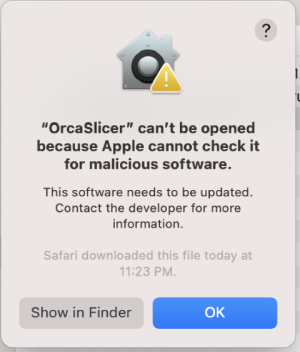
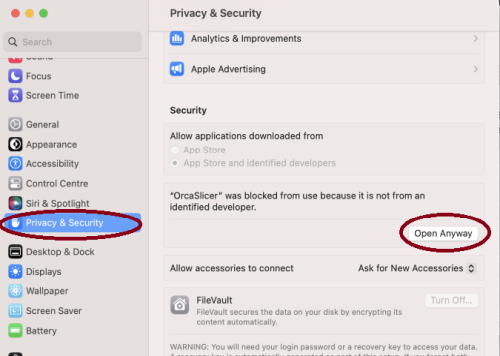
- Step 2: in
System Settings->Privacy & Security, clickOpen Anyway:
- Step 1: open the app, a warning window will pop up
-


Homebrew Cask
brew install --cask orcaslicer
The Homebrew cask installs the official macOS DMG from GitHub Releases.
Linux
Flathub (Recommended)
OrcaSlicer is available through FlatHub:

Install from the command line:
flatpak install flathub com.orcaslicer.OrcaSlicer
flatpak run com.orcaslicer.OrcaSlicer
It can also be installed through graphical software managers (KDE Discover, GNOME Software, etc.) when Flathub is enabled. Search for OrcaSlicer in your software center.
AppImage
AppImages are published for both x86_64 and aarch64 (ARM64). Pick the file matching your CPU — the ARM64 build has aarch64 in its name (e.g. OrcaSlicer_Linux_AppImage_Ubuntu2404_aarch64_*.AppImage).
-
Download App image from the releases page.
-
Double click the downloaded file to run it.
-
If you run into trouble executing it, try this command in the terminal:
chmod +x /path_to_appimage/OrcaSlicer_Linux.AppImage
How to Compile
All updated build instructions for Windows, macOS, and Linux are now available on the official OrcaSlicer Wiki - How to build page.
Please refer to the wiki to ensure you're following the latest and most accurate steps for your platform.
Klipper Note
If you're running Klipper, it's recommended to add the following configuration to your printer.cfg file.
# Enable object exclusion
[exclude_object]

# Enable arcs support
[gcode_arcs]
resolution: 0.1
Supports
OrcaSlicer is an open-source project, and we're deeply grateful to all our sponsors and backers.
Their generous support helps fund filaments and other essential 3D printing materials for the project.
Thank you! :)
Sponsors

|

|
Backers:
Ko-fi supporters ☕: Backers list
Support the project




Some Background
Open-source slicing has always been built on a tradition of collaboration and attribution. Slic3r, created by Alessandro Ranellucci and the RepRap community, laid the foundation. PrusaSlicer by Prusa Research built on Slic3r and acknowledged that heritage. Bambu Studio in turn forked from PrusaSlicer, and SuperSlicer by @supermerill extended PrusaSlicer with community-driven enhancements. Each project carried the work of its predecessors forward, crediting those who came before.
OrcaSlicer began in that same spirit, drawing from BambuStudio, PrusaSlicer, and ideas inspired by CuraSlicer and SuperSlicer. But it has since grown far beyond its origins. Through relentless innovation — introducing advanced calibration tools, precise wall and seam control, tree supports, adaptive slicing, and hundreds of other features — OrcaSlicer has become the most widely used and actively developed open-source slicer in the 3D printing community. Many of its innovations have been adopted by other slicers, making it a driving force for the entire industry.
The OrcaSlicer logo was designed by community member Justin Levine.
License
- OrcaSlicer is licensed under the GNU Affero General Public License, version 3.
- The GNU Affero General Public License, version 3 ensures that if you use any part of this software in any way (even behind a web server), your software must be released under the same license.
- OrcaSlicer includes a pressure advance calibration pattern test adapted from Andrew Ellis' generator, which is licensed under GNU General Public License, version 3. Ellis' generator is itself adapted from a generator developed by Sineos for Marlin, which is licensed under GNU General Public License, version 3.
- The Bambu networking plugin is based on non-free libraries from BambuLab. It is optional to the OrcaSlicer and provides extended functionalities for Bambulab printer users.