Fusion 360 .f3d uses Autodesk's closed ShapeManager kernel — no offline
reader exists and it is input-only even in Autodesk's own cloud API, so
native import/export is infeasible. Intercept .f3d at priv::load_files
(the single funnel for drag-drop and File > Open) and show a dialog
pointing the user to export STEP from Fusion, then load any other files
in the batch.

Co-Authored-By: Claude Opus 4.8 <noreply@anthropic.com>
Claude-Session: https://claude.ai/code/session_01BVzKmX6Y1aEteit1HTXG4Q
Mirror of snaporca-cad ad822bf. The earlier mirror (2c0140afb9) implemented
persistence in the PrusaSlicer 3mf.cpp, but the GUI saves/loads projects via the
BBS-native backend (store_bbs_3mf / load_bbs_3mf), so the recipe was never
written to nor read from GUI-saved projects.

- bbs_3mf.cpp: BBS_CAD_RECIPE_FILE = "Metadata/SnapOrca_cad.bin"; writer
  _add_cad_recipe_file_to_archive (called after layer-height in store_bbs_3mf);
  reader branch in _load_model_from_file's metadata dispatch loop (iterate +
  iequals on m_filename — mz_zip_reader_locate_file does not work on these
  archives).
- Plater.cpp: load_files carries the Model-level cad_recipe onto q->model().
- test_3mf.cpp: [3mf] test asserting store_bbs_3mf embeds the recipe entry
  byte-for-byte (read back via miniz, Catch2 v3).

Verified on behemoth: libslic3r_tests + the new [3mf] BBS test pass; orca-slicer
GUI links clean. Round-trip verified live on snaporca-cad (identical code path).

Co-Authored-By: Claude Opus 4.8 <noreply@anthropic.com>
Claude-Session: https://claude.ai/code/session_01BVzKmX6Y1aEteit1HTXG4Q
Catches the iXex/IDEX branch up to upstream main (44 commits). One
content conflict resolved:

- src/libslic3r/Print.hpp: kept upstream's default-initialized
  m_origin {0,0,0} alongside our m_imex_slice_offset member.

Co-Authored-By: Claude Opus 4.8 (1M context) <noreply@anthropic.com>
Catches the iXex/IDEX parallel-printing branch up to upstream main
(102 commits). Two content conflicts resolved:

- src/libslic3r/Preset.cpp: s_Preset_printer_options — kept upstream's
  new "use_3mf" key and our iMEX printer-capability/mode keys.
- tests/fff_print/test_gcodewriter.cpp: upstream revived the disabled
  suite (#14196), dropping the obsolete [.]-tagged lift() test and its
  config_lift_unlift.ini; kept their set_speed + z_hop tests and appended
  our 10 per-firmware set_pressure_advance/set_temperature scenarios.

Co-Authored-By: Claude Opus 4.8 (1M context) <noreply@anthropic.com>
feat: forward plateindex for index-coded .gcode.3mf uploads

Gcode inside a .gcode.3mf is index-coded (Metadata/plate_<N>.gcode) and a
bundle may carry several, so the upload must name which plate to print —
even a single-plate bundle, since its entry is still indexed.

A 1-based plate index is stored in PrintHostUpload::extended_info when use_3mf
is set; the OctoPrint and Moonraker hosts forward it as a `plateindex` form
field. Servers that don't use it ignore the unknown field, so the plain G-code
path is unchanged.
* Degrees symbol don't need localization

* The Z when referring to the axis should be uppercase

* Fix the spelling of "GitHub" to camelcase

* Unify the casing of mouse button shortcuts

* Always use G-code with an hyphen

* Fix the spelling of "restricted"

* More grammar fixes

* add missing modifications

---------

Co-authored-by: SoftFever <softfeverever@gmail.com>
* feat: add support for 3MF file format in printer configurations and export options

* fix file extension

* enable 3mf for X Max 4

* disable use_3mf for X Plus 4

* Fixed an issue where `label_object_enabled` was not properly propagated to 3mf

* enable exclude object for Max 4

* remove hardcoded use 3mf for flashforge, move them to the new printer profiles config
Belt printers can't slice a tall vertical temperature tower. This adds a
belt-specific temperature-tower model — a row of discrete, individually
engraved provini laid along the belt, each printed at one temperature via
custom per-layer M104. Each provino is an inverted-L overhang that stresses
print quality, so the operator reads the best temperature off overhang
quality rather than a continuous ramp.

It is offered as a "Test model" choice in the temperature calibration dialog
(mirroring the Cornering test's selector), so users keep Joe's counter-rotated
sectioned tower as "Standard" and can pick this one as "Overhang":
- Calib_Params::test_model (existing field) carries the choice.
- Temp_Calibration_Dlg gets a Standard/Overhang radio.
- Plater::calib_temp belt branch: test_model 0 -> _calib_temp_belt_sectioned
  (unchanged Standard path), 1 -> the discrete-provini Overhang path.

Assets: belt_temp_provino_unit.stl + belt_temp_tower_<start>_<end>.stl (6
ranges) + gen_belt_temp_tower.py (manifold engraving). Based on
belt/generic-calibrations. The Overhang path is HW-validated on the IdeaFormer
IR3 V2 (discrete M104 + engraved numbers); not re-validated since the rebase.
Enables supported printing of standard Orcaslicer calibration profiles.

* Build 2 Checkpoint

* fix support generation wedge, ghost layers

* flip cornering tests 180 deg to waste less supports

* fix row spacing on the flow ratio calibrations

* more testing, this didn't fix anything

* switched rotation tools, same issue

* fixed Z-offset issues

* add rest of PA features, may look a bit weird on a belt

* make temp towers work

* re-enable spiral on calibrations that want it

* Final cleanup pre-PR and community testing
124 upstream commits including CrealityPrint integration (added include
in Plater.cpp alongside the existing IMEXHelpers include), profile fixes
and version bumps (#14084, #14085, Polymaker), CI artifact publishing,
test refactors (arachne walls test added; test_3mf/test_config/
test_gcodewriter content moved/removed upstream — IMEX test file
preserved as it is feedback-only), translations.
## Summary
Adds end-to-end Creality K-series (K2 / K2 Plus / K2 Pro) host support
to OrcaSlicer in a single bundle, per [@SoftFever's request to
consolidate](https://github.com/OrcaSlicer/OrcaSlicer/pull/13752#issuecomment-4560837450)
the previously stacked PRs. Three logically separable features, all
gated on `host_type=crealityprint`:
1. **LAN auto-discovery** — `Browse...` in the Physical Printer dialog
now finds K-series printers on the local network via a DNS-SD
meta-browser (per-device-unique service names
`_Creality-<MAC>._udp.local.`). Other host types unchanged.
2. **CFS filament sync** — `CrealityPrintAgent` (inheriting
`MoonrakerPrinterAgent`) queries the K-series WebSocket on `:9999` for
`boxsInfo`, maps loaded CFS slots to Orca filament presets, and
populates the Sidebar via the standard `fetch_filament_info` →
`build_ams_payload` path. Matches the shape of `MoonrakerPrinterAgent` /
`QidiPrinterAgent` / `SnapmakerPrinterAgent` per [the earlier review
feedback](https://github.com/OrcaSlicer/OrcaSlicer/pull/13752#discussion_r3278574545).
3. **K-series filament profiles** — system profiles for CR-PLA / CR-PETG
/ CR-ABS / CR-Silk / CR-TPU / CR-Nylon / CR-Wood / Hyper PLA / etc. on
K2 / K2 Plus / K2 Pro nozzle sizes (imported from CrealityPrint v7.1.0+,
normalised to OrcaSlicer profile conventions).
The previous stack base (#13291, *CrealityPrint as host type*, by
@imammedo) is **also bundled into this PR** since it's currently
conflicting with main and not moving. Happy to extract it back out if
@imammedo's PR is preferred to land first for attribution — let me know.
## What this PR is *not*
- **No new UI surfaces.** All three features hook into existing UI
(Browse button, Sidebar sync icon, filament dropdowns).
- **No phone-home / telemetry.** No Hark Tech endpoints, no licence
checks, no opt-in dialogs. Pure upstream feature work.
- **No K-series-specific Device tab.** Embedded WebView falls back to
Fluidd/Mainsail on `:4408`, same shape as the existing Moonraker
integration.
## Screenshots
Captured against a K2 Combo (F021, firmware v1.1.260206) on the v4 test
build:
| | |
|---|---|
| 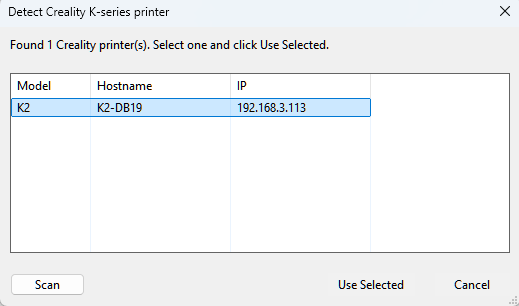
| **Discovery dialog** — `Browse...` flow on a `host_type=crealityprint`
printer. Click → ~5–10 s LAN scan → K2 found with model + hostname + IP.
|
| 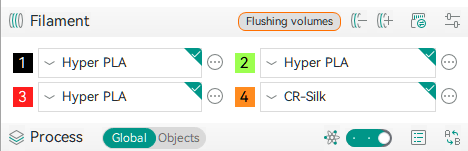
| **CFS filament sync** — Sidebar after clicking the sync icon: 4 slots
populate with the real loaded CFS spools (3× Hyper PLA + 1× CR-Silk). |
| 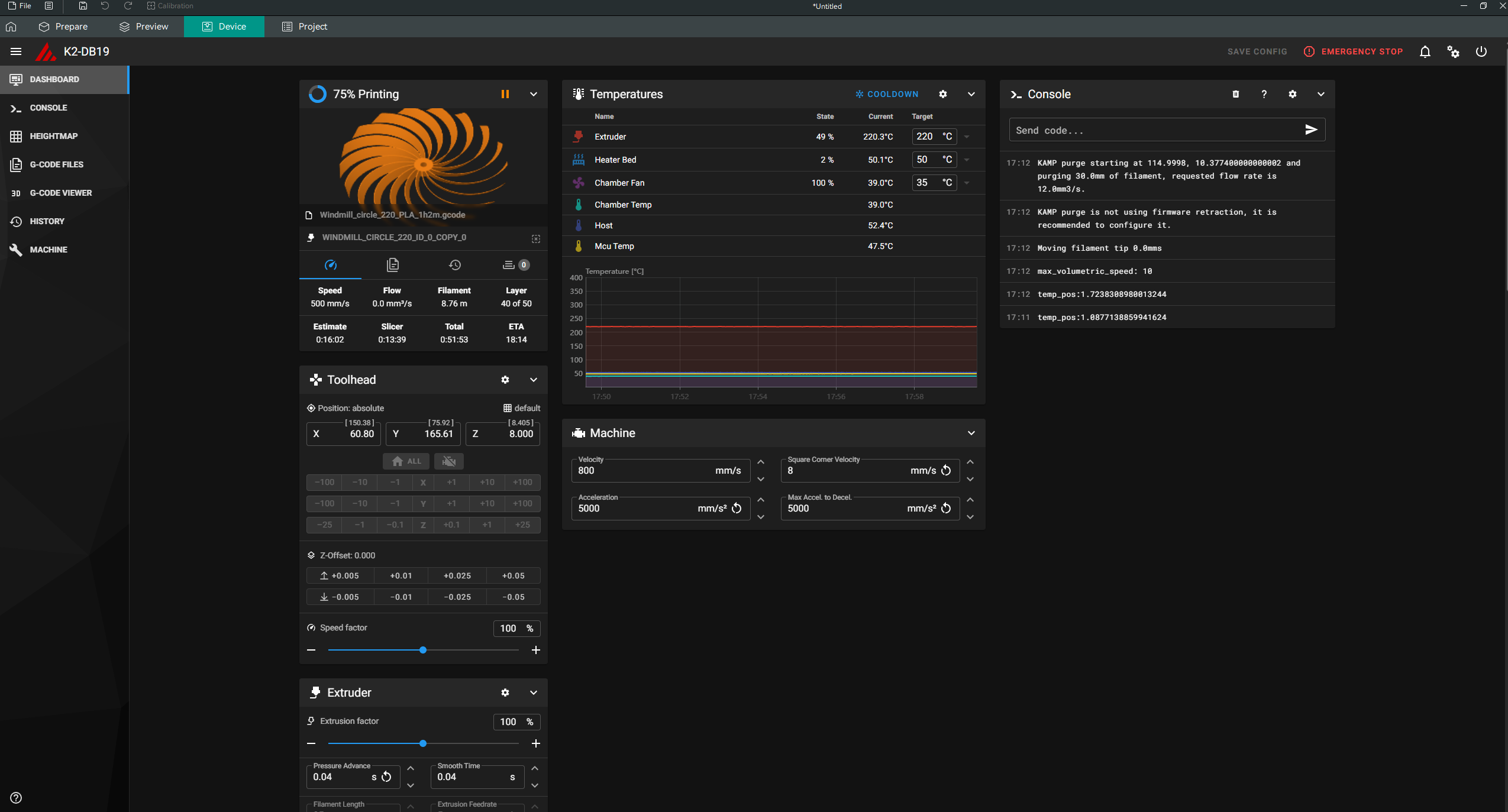
| **Device tab** — Mainsail loaded into the embedded WebView for
`host_type=crealityprint`, mid-print state visible. |
## What's added
### LAN discovery
- **`deps_src/mdns/`** — vendors
[mjansson/mdns](https://github.com/mjansson/mdns) (public domain) plus
Creality's `cxmdns` C++ wrapper from CrealityPrint v7.1.1 (AGPL-3.0,
compatible with OrcaSlicer's AGPL-3.0). Attribution in
`deps_src/mdns/NOTICE.md`.
- **`Utils/CrealityHostDiscovery.{hpp,cpp}`** — synchronous DNS-SD scan
+ per-host `GET /info` probe. Maps model codes `F008` / `F012` / `F021`
→ K2 Plus / K2 Pro / K2.
- **`GUI/CrealityDiscoveryDialog.{hpp,cpp}`** — modal `wxDialog` showing
Model / Hostname / IP for each discovered host.
- **`src/slic3r/CMakeLists.txt`** — adds `Iphlpapi.lib` and `Ws2_32.lib`
to `libslic3r_gui`'s MSVC link line (needed by `GetAdaptersAddresses` +
Winsock2 calls in vendored `mdns.c`).
### CFS filament sync
- **`Utils/CrealityPrintAgent.{hpp,cpp}`** — inherits
`MoonrakerPrinterAgent`, overrides `fetch_filament_info()` to query the
K-series WS protocol on `:9999`, build `AmsTrayData`, and call inherited
`build_ams_payload()`. No printer-specific code lives outside the agent.
- K2 Plus slot-state parser handles the three documented slot states
(`0` empty / `1` manually entered / `2` RFID-tagged) per [DaviBe92's
reverse-engineering docs](https://github.com/DaviBe92/k2-websocket-re).
### K-series filament profiles
- ~110 profile JSONs under `resources/profiles/Creality/filament/`
covering K2 / K2 Plus / K2 Pro × 0.2 / 0.4 / 0.6 / 0.8 nozzle combos ×
CR-PLA / CR-PETG / CR-ABS / CR-Silk / CR-TPU / CR-Nylon / CR-Wood /
Hyper PLA / Hyper PETG-GF / Hyper PLA-CF / etc.
- Imported from CrealityPrint v7.1.0; normalised to OrcaSlicer profile
conventions (tabs not spaces, no `{if !multicolor_method}` wrappers,
`filament_vendor: ["Creality"]` on Creality Generic profiles).
## Tester confirmations on the v4 test build
| Printer | Firmware | Result | Reporter |
|---|---|---|---|
| K2 Pro | v1.1.5.5 / CFS v1.4.2 | ✅ LAN discovery on #13752 test build
|
[@Requiem-MH](https://github.com/OrcaSlicer/OrcaSlicer/pull/13752#issuecomment-4495235225)
|
| K2 Pro | v1.1.5.5 / CFS v1.4.2 | ✅ CFS sync across 1-CFS, 2-CFS,
partial, full configurations |
[@Requiem-MH](https://github.com/OrcaSlicer/OrcaSlicer/pull/13744#issuecomment-4495230061)
|
| K2 Plus | v1.1.5.2 / CFS v1.2.2 | ✅ Slot-state fix resolves the
partial-sync regression |
[@DaviBe92](https://github.com/OrcaSlicer/OrcaSlicer/pull/13744#issuecomment-4499425852)
|
| K2 Plus | v1.1.5.5 / CFS v1.4.2 | ✅ All slots syncing correctly after
fix |
[@swilsonnc](https://github.com/OrcaSlicer/OrcaSlicer/pull/13744#issuecomment-4503273127)
|
| K2 Plus | (Reddit u/TrainAss) | ✅ Both PLA + PETG slots populated
correctly |
[@TrainAss](https://github.com/OrcaSlicer/OrcaSlicer/pull/13744#issuecomment-4503401664)
|
| K1C | (latest stock) | ✅ `boxsInfo` payload format compatible (4 slots
of generic PETG) |
[@JoveYu](https://github.com/OrcaSlicer/OrcaSlicer/pull/13744#issuecomment-4519036448)
|
## Known follow-ups (out of scope)
- **Snapmaker U1 regression**
([@TrainAss](https://github.com/OrcaSlicer/OrcaSlicer/pull/13744#issuecomment-4529350262)):
the v3 build also happened to sync filament from his U1; v4 regressed
this. The refactor only touches `htCrealityPrint`-gated code so this is
likely incidental — needs his config + logs to diagnose. Will follow up
in a separate issue once this lands.
- **Native Device tab for K-series**: deferred. Current Mainsail WebView
shim covers the common case.
- **#13581 (@hamham999) profile overlap**: confirmed minimal code
conflict (zero), profile-file overlap of ~204 files. Whichever PR lands
second rebases off the other.
## Test plan
- [x] Linux build clean on commit `<UPDATED AFTER BUILD>` (LXC 104, GCC
12, cmake)
- [x] MSVC link clean (manual VS 2026 / MSVC 14.51 build)
- [x] End-to-end on real hardware: K2 Combo, K2 Pro, K2 Plus, K1C
- [x] `host_type ≠ htCrealityPrint` paths unchanged — Bonjour fires for
OctoPrint, Flashforge picker fires for Flashforge, Moonraker / Qidi /
Snapmaker agents unchanged
- [x] Profile-validation CI green (was a separate Elegoo test-fixture
failure on main, not introduced by this PR)
Signed-off-by: Igor Mammedov <niallain@gmail.com>
Co-authored-by: Igor Mammedov <niallain@gmail.com>
Co-authored-by: grant0013 <grant@harktech.co.uk>
Co-authored-by: SoftFever <softfeverever@gmail.com>
Co-authored-by: hamham999 <hamham999@users.noreply.github.com>
Co-authored-by: Alys Andreollo <3528187+alysandreollo@users.noreply.github.com>
Includes nozzle-diameter guards for printers without nozzle info (#13255,
now landed upstream) and manual-calibration nozzle mismatch fix (#13882).

# Conflicts:
#	src/slic3r/GUI/GCodeViewer.cpp
#	src/slic3r/GUI/GLCanvas3D.hpp
#	src/slic3r/GUI/Tab.cpp
* Support 'Default' filament option (index 0)

Treat filament index 0 as the new "Default" (use active object/part filament) instead of using 1. Update config defaults and tooltips for wall/sparse/solid infill filament options (min/default -> 0, tooltip explains "Default"). Adjust normalization and propagation logic to respect explicit feature overrides and only apply base extruder when feature values are zero; only copy sparse->solid infill when sparse > 0. Introduce FeatureFilamentOverrideMask and clamp_feature_filament_to_valid to resolve and clamp feature filaments. Update UI lists and selection behavior to expose a "Default" entry and handle zero-based indices in PartPlate and Plater.

* enable_filament_for_features option

Co-Authored-By: LixNix <105106115+lixnix@users.noreply.github.com>

* \n

* Allow wipe_tower_filament to equal nozzle count

Relax the assertion in Print::extruders to permit wipe_tower_filament == config().nozzle_diameter.size(). The configuration value is 1-based and the code subtracts 1 when pushing the extruder index, so equality should be valid and selecting the last nozzle should not trigger an assertion.

* Revert "Allow wipe_tower_filament to equal nozzle count"

This reverts commit 2c976574327a8bcdc74a1b296bf1aaff7752a94e.

* Revert "enable_filament_for_features option"

This reverts commit 01c13baeddb8e26793f752deab788ee4d086975b.

* Migrate legacy feature filament defaults

Add migration logic to convert legacy feature filament selections from 1 to 0 for older 3mf files. Introduces a local migrate_legacy_feature_filament_defaults lambda in src/OrcaSlicer.cpp and src/slic3r/GUI/Plater.cpp that scans keys (wall_filament, sparse_infill_filament, solid_infill_filament, support_filament, support_interface_filament) on configs/objects/volumes, updates values, counts conversions and logs the result. Also adds a Semver check for "2.4.0-dev" in OrcaSlicer to trigger the migration for files older than that version. This preserves expected default filament selections when loading older project files.

* Update OrcaSlicer.cpp

* Extract migration helper to ConfigMigrations

Centralize legacy feature-filament default migration by moving the duplicated lambda into ConfigMigrations::migrate_legacy_feature_filament_defaults (src/libslic3r/Config.cpp) and declaring it in Config.hpp. Update OrcaSlicer.cpp and slic3r/GUI/Plater.cpp to call the new function instead of inline lambdas. The helper converts specific feature filament keys (wall_filament, sparse_infill_filament, solid_infill_filament, support_filament, support_interface_filament) from int 1 to 0 and returns the count of conversions to avoid duplicated migration logic.

* Remove DynamicFilamentList1Based and consolidate lists

Delete the specialized DynamicFilamentList1Based struct and its global instance. Update Choice registrations to use the single dynamic_filament_list for wall, sparse_infill and solid_infill filaments, and remove the extra update call for the removed instance. This consolidates filament choice handling and removes duplicated logic in Plater.cpp.

* move it

* fix objects

* Update Config.hpp

* Update profiles
Consolidates #13744 (CFS filament sync) into this PR per maintainer
request and resyncs with main. Conflicts resolved:

* src/slic3r/GUI/Plater.cpp -- parallel else-if added by both sides
  (htCrealityPrint + flashforge_local_api branches); kept both.
* src/slic3r/GUI/PhysicalPrinterDialog.cpp -- both sides added a
  host-specific Browse dialog (Creality DNS-SD + Flashforge); kept
  both as early-return branches, fall through to BonjourDialog.
* src/slic3r/GUI/PrintHostDialogs.hpp -- parallel class declarations
  (CrealityPrintHostSendDialog + FlashforgePrintHostSendDialog);
  kept both.
When the OrcaSlicer window is on an inactive Hyprland (or any Wayland
compositor that keeps surfaces mapped while hidden) workspace, GTK
keeps delivering synthetic leave-notify events to the printer-preset
row. The wxEVT_LEAVE_WINDOW handler at Plater.cpp:1855 calls
wxFindWindowAtPoint(), which walks the entire wxWidgets window tree
calling IsShown() / gtk_widget_get_child_visible() on each widget,
then Hide()s the edit button and triggers a Layout() of the parent
panel. The Hide()+Layout() re-fires more leave events, creating a
feedback loop that pegs a CPU core at 100% indefinitely.

GDB attached to a frozen process confirmed the main thread stuck in:

  wxFindWindowAtPoint (recursing through widget tree)
    -> wxWindow::IsShown
      -> gtk_widget_get_child_visible
  ...
  Sidebar::Sidebar(Plater*)::$_14   <- the leave handler lambda
  wxEvtHandler::SafelyProcessEvent
  wxGTKImpl::WindowLeaveCallback
  gtk_main_do_event
  ...

IsShownOnScreen() can't be used as a guard here because GTK on Wayland
reports widgets as visible even when the toplevel surface is on an
inactive workspace (see existing comment at Plater.cpp:9304).

Fix: state-based short-circuit. If btn_edit_printer is already hidden,
the handler has no transition to perform - skip the expensive tree walk
and the Hide()+Layout() that would re-trigger the feedback loop. After
the first leave event, every subsequent leave event is O(1).

Refs:
- #12387 (open issue with matching setup: Arch + Hyprland + RTX 3060 + Bambu A1)
- #11196 (introduced the hover-edit-button feature in Nov 2025)
 SoftFever


