# Description
Adds a sketch-first parametric CAD tab to the slicer: sketch → constrain
→ solid features
→ commit to plate. The feature recipe is persisted inside the 3MF, so
reopening a project
restores an editable model rather than a frozen mesh.
Opening this at @SoftFever's request, so the code is easier to read than
a fork.
**The number worth reading first:** the diff is large, but almost all of
it is new files.
Existing upstream code is touched in **23 files, +622 / -88 total**.
That is the entire
negotiable surface. The largest single one is `GLCanvas3D.cpp` at
+149/-14 (a pick path for
the CAD viewport); everything else is under 60 lines.
One thing about the raw diff: the file count includes everything new,
and the negotiable
surface is the 23 modified files above. Thanks for merging `main` in —
the branch is current
again, and I have kept building on top of it.
The regenerated i18n catalogues (`OrcaSlicer.pot`, `OrcaSlicer_it.po`,
`list.txt`) have been
kept OUT of this branch deliberately — they were 27,314 added lines of
build product standing
between you and the code. They regenerate from source with
`scripts/run_gettext.sh` whenever
you want them refreshed. A Romanian catalogue that had been riding along
was pulled out at
the same time — a translation has no business being reviewed inside a
CAD feature PR.
| | |
|---|---|
| Kernel | OCCT — already linked for STEP import. The dependency delta
is one line: `BUILD_MODULE_ModelingAlgorithms=OFF → ON`. Measured cost
in
[`docs/cad_dependency_weight.md`](https://github.com/tommasobbianchi/Orca-Cad/blob/cad-mainline/docs/CAD/cad_dependency_weight.md)
|
| Constraint solver | vendored SolveSpace `libslvs` subset, 21 files /
~10k lines under `src/libslic3r/slvs/` |
| Build gate | `SLIC3R_CAD` (default ON). With it OFF the tab is not
compiled and the deps prefix matches upstream exactly |
| Persistence | CAD recipe embedded in both the 3MF and BBS-3MF writers
|
| User docs |
[`docs/design_tab.md`](https://github.com/tommasobbianchi/Orca-Cad/blob/cad-mainline/docs/CAD/design_tab.md)
|
| Interaction model | object-driven — point at geometry, it offers the
verbs that apply:
[`docs/cad_ux_guidelines.md`](https://github.com/tommasobbianchi/Orca-Cad/blob/cad-mainline/docs/CAD/cad_ux_guidelines.md)
|
### Why it belongs in the slicer
Every round trip through an external CAD tool costs an export, a
re-import, and the design
intent both steps discard. A part changed after slicing should come back
to its feature
history, not to a mesh. Keeping the model in the slicer preserves that
loop — nozzle
diameter, build volume and material are known at design time. Longer
argument in
[`docs/design_tab_upstream_portability.md`](https://github.com/tommasobbianchi/Orca-Cad/blob/cad-mainline/docs/CAD/design_tab_upstream_portability.md).
### Two things I'd rather you hear from me than find
**Licensing.** The vendored solver is **GPL-3.0**, not LGPL
(`src/libslic3r/slvs/LICENSE`).
The combined work is distributable under AGPL-3.0 and the compatibility
argument is written
out in the portability doc, but this is a project-level decision and I
would like it
confirmed explicitly rather than assumed. If GPL-3.0 in-tree is not
acceptable, the solver
is the separable part — the timeline, features and persistence do not
depend on it.
**One CMake change is larger than it looks.** `CMakeLists.txt` is
+41/-56: it replaces a
hand-maintained list of OCCT DLLs to copy on Windows with a glob plus an
assertion that
every linked toolkit actually has a DLL. The explicit list had already
drifted from what
`libslic3r` links and shipped a portable that died at launch with `error
126`. Happy to
split that out into its own PR if you'd prefer it reviewed separately.
### Not verified
- No automated GUI test. A green kernel run says nothing about the
viewport — synthetic
clicks never drift, so the suite and the UI are two separate realities.
- Card wiring for 9 of the 16 late-wired tools has never been
click-tested.
- The click-test defect rate has not converged: one pass found nothing,
four further days
of work found five more defects. I would not present the quiet pass as
evidence of
stability.
# Screenshots/Recordings/Graphs
One part, start to finish: sketch it, feature it, print it — without
leaving the slicer.
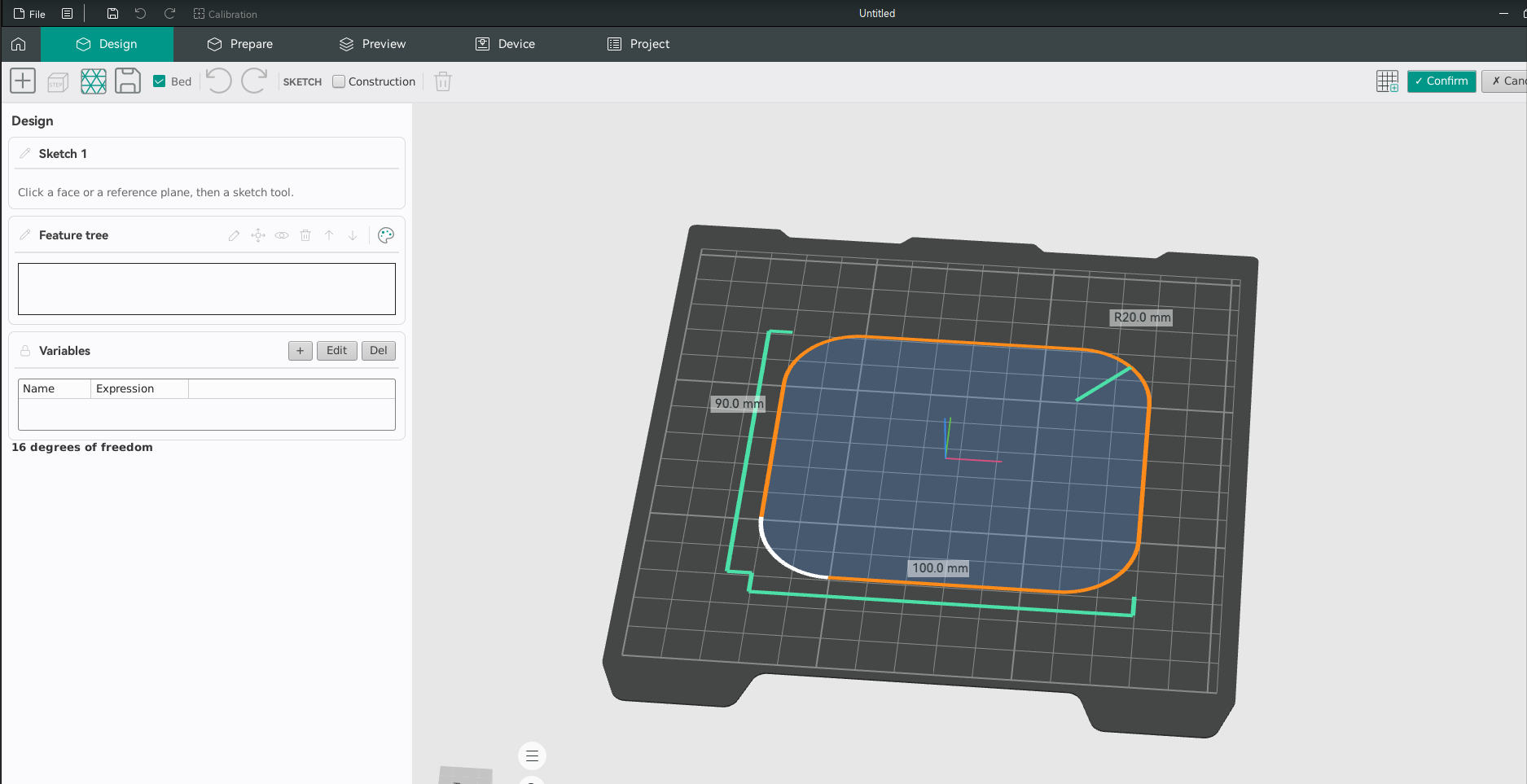
**1. Sketch, constrained and dimensioned.** A 100 × 90 rounded rectangle
drawn straight onto
the bed, R20 corners, live dimensions, and the solver's remaining
degrees of freedom reported
in the panel. The bed is the sketch plane, so the part is sized against
the machine it will be
printed on from the first line.
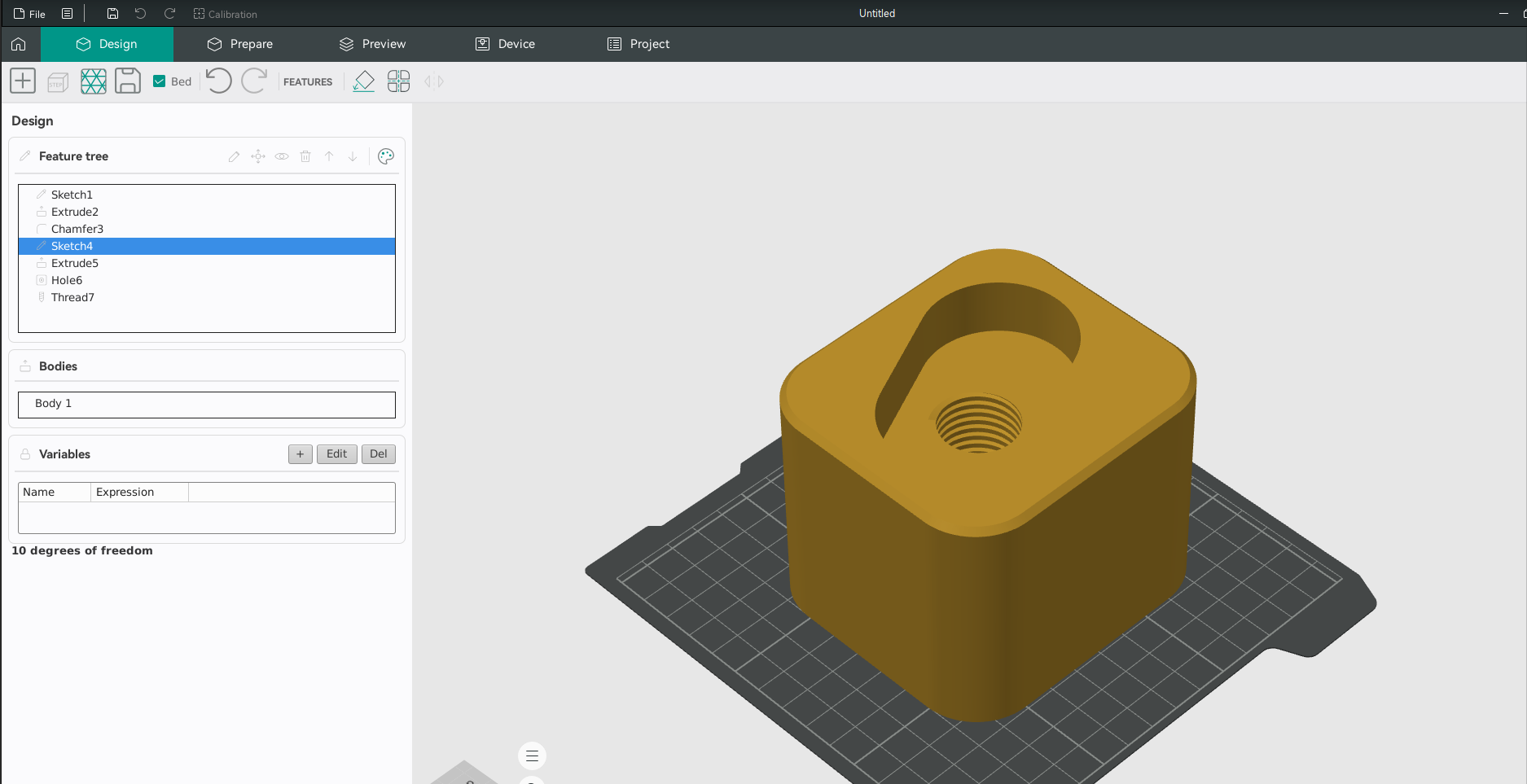
**2. The feature tree is the part.** `Sketch1 → Extrude2 → Chamfer3 →
Sketch4 → Extrude5 →
Hole6 → Thread7`. Every step stays editable and re-evaluates downstream
— the modelled thread
in the boss is a real helical feature, not a texture.
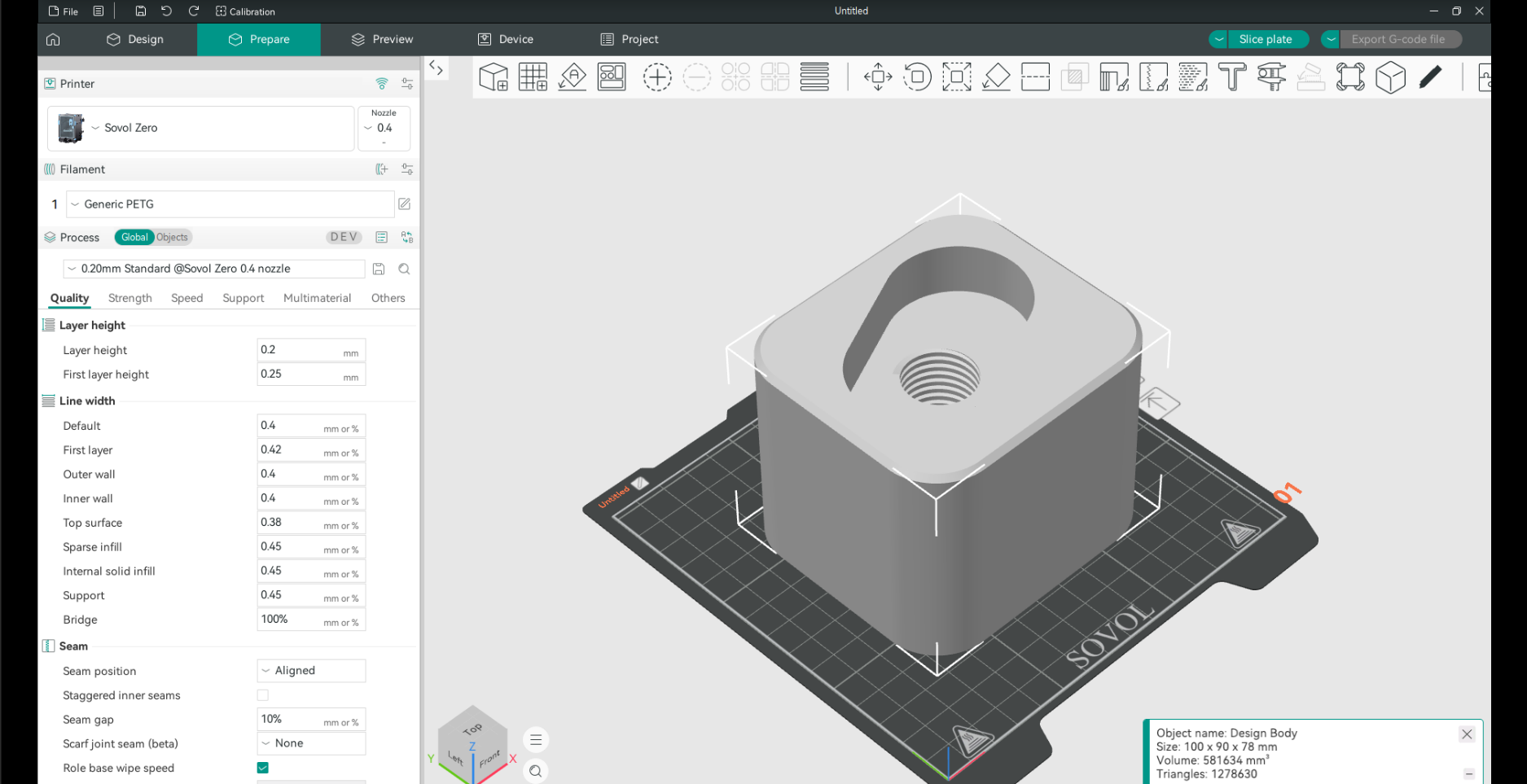
**3. Committed to the plate.** The same body arrives in Prepare as
`Design Body`,
100 × 90 × 78 mm, 581,634 mm³, ready for a Sovol Zero and PETG. No
export, no re-import, no
lost design intent.
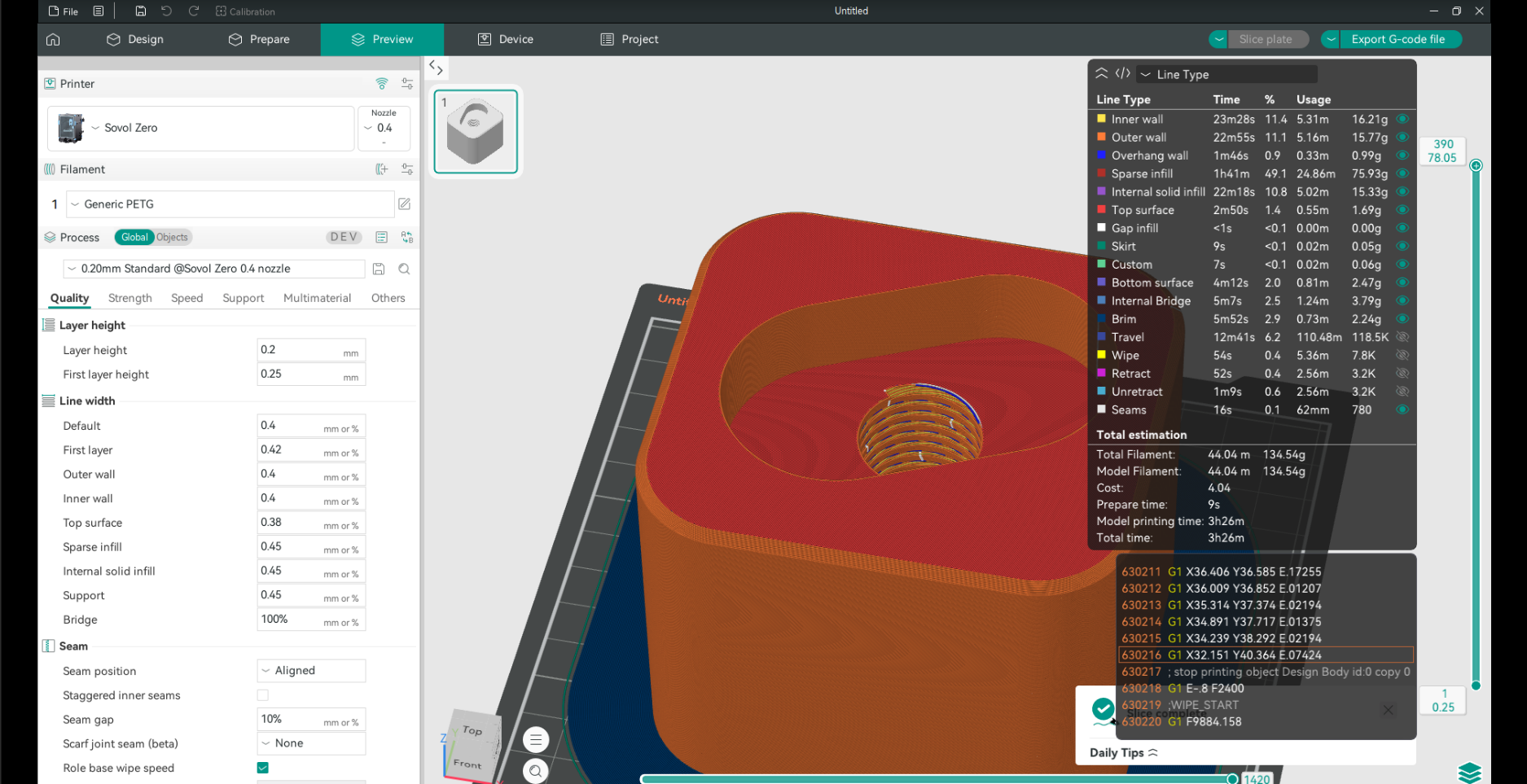
**4. Sliced.** The thread comes out as real helical toolpaths, and the
estimate is 3h26m /
134.54 g. This is the whole argument for the feature in one frame: the
geometry that was
parametric two screens ago is now G-code, and it is still parametric if
you go back.
## Tests
215 `TEST_CASE` blocks across 6 new test files, plus 2 `SCENARIO`s added
to
`tests/libslic3r/test_3mf.cpp` covering the CAD recipe's round trip
through both 3MF
writers. `scripts/kernel-test.sh` is the headless contract: it builds
only
`libslic3r_tests`, needs no display, and exit 0 means the CAD suite
passed.
Happy to slice this differently — kernel + solver first, GUI second — if
that reviews
better for you.
Merged by /bot merge on behalf of @JAYO3D-Official (id 320896770).
Grants: resources/profiles/OrcaFilamentLibrary/filament/JAYO, resources/profiles/OrcaFilamentLibrary.json
Head: fb9a6d70a0
* Run every profile maintenance job from one tool

orca_id_tool.py becomes orca_profile_tool.py, and orca_extra_profile_check.py
and orca_filament_lib.py fold into it as subcommands: check, generate-id, fix,
trim, update-index and update-snapshot. The three scripts already overlapped --
the checker imported half of its rules from the id tool, which in turn kept a
copy-pasted set of output helpers to avoid the resulting import cycle -- while
disagreeing on how a vendor is enumerated, how a JSON file is read and what the
exit code means. One file settles all three.

check, normalize, trim and update-index reproduce their predecessors exactly; normalize and
update-index were diffed byte-for-byte against the old scripts over a copy of
the whole tree. Deliberate changes: the compatible-printers check no longer
switches itself off when --check-materials is passed, an error exits 1 rather
than -1, update-index honours --profile-type and reports a profile it cannot
place instead of dropping it from the index, fix and update-index gained
--dry-run, trim keeps an unindexed file some surviving profile still inherits
from, and vendors are enumerated as directories with an index -- which is why
blacklist.json, a data file that an unscoped index rebuild once wrote four empty
list sections into, loses them here and will not collect them again. The dead
rename_filament_system() helper is gone.

The suite under scripts/tests now covers the maintenance commands too, and CI
runs it; nothing there ran in CI before. No shipped profile data changes apart
from those four keys.

* update vendor index files with "python3 ./scripts/orca_profile_tool.py update-index" and "python3 ./scripts/orca_profile_tool.py normalize"
The U1's heated bed tops out at 100 °C, but these profiles requested
105-110 °C, which leads to print errors unless the user modifies the
printer's firmware configuration.

Affected profiles:
- Snapmaker ABS @U1 base (110/105 → 100)
- Snapmaker ASA @U1 base (110 → 100)
- Fiberon ASA-CF08 @Snapmaker U1 base (105 → 100)
- Fiberon PPS-GF20 @Snapmaker U1 base (105 → 100)

Bumps Snapmaker.json to 02.04.00.10.

Co-authored-by: yw4z <ywsyildiz@gmail.com>
The bed was declared as 0x0, 20x0, 200x200, 0x200 - a triangle - where the
0.4 nozzle profile and the printer have the 200 x 200 square. Found by the
profile validator once it placed the prime tower beside the test cube:
no tower fits inside that outline.
"Snapmaker PLA-CF @U1" and "Snapmaker PLA-CF @U1 0.4 nozzle" are the same
product on the same printer: both pin "Snapmaker U1 (0.4 nozzle)", and only a
filament_id salt split kept them apart. The first came with the original U1
profiles (#10225); the second with the tool-changer rework (#15039), which
added the 0.4/0.6/0.8 nozzle variants and left the older preset behind.

Drop the older one and re-mint the 0.4 variant onto OFhQf8ou, the id its 0.6
and 0.8 siblings already carry, so the product holds one id across the three
nozzles; renamed_from redirects the retired name. Users of the retired preset
get the #15039 tuning - 39 keys differ, including nozzle 230 -> 240 C, plate
55 -> 65 C and vitrification 150 -> 45 C - which is what the 0.6 and 0.8
variants already ship.

"Snapmaker PLA-CF @U1 base" stays. #15039 orphaned it by having the nozzle
variants inherit fdm_filament_pla directly, so it is unreferenced, but it is a
base in the vendor's own convention - 10 of the 14 @U1 families with nozzle
variants wire them to one - and it holds U1 loading and cooling values the
variants never set. Wiring them to it would change slicing output, which is
Snapmaker's call to make, not this PR's.

Claude-Session: https://claude.ai/code/session_01Q3zm9HuyskkSb4hynviV99
"Update re:3D profiles" (#13750) added the tuned "@0.4/@0.8 nozzle" and
"@0.8/@1.75 nozzle" variants but kept the five original un-suffixed presets,
trimming each to a stub that overrides only filament_vendor while still
claiming every printer of both nozzles. On any re3D printer the stub was
selectable alongside the ~50-key variant that actually tunes the material,
which is what forced five filament_id salt splits to keep the pair apart.

Drop the stubs. The variants already carry the products' ids, so nothing is
re-minted; renamed_from redirects each retired name to the smaller-nozzle
variant, and "re3D rPETG @0.8 nozzle" additionally takes over the
"re3D Greengate rPETG" mapping that lived on the deleted umbrella. Each
printer model's default_materials now lists the variants for its own
nozzles rather than the stub.
Cubicon's nine "@base" presets were the only instantiated ones of the 196
"@base" filament presets in the library; the other 187 are instantiation:false.
Being selectable, and claiming xCeler-I and xCeler-Plus, they put two presets of
one product on those two printers - which is what forced the nine filament_id
salt splits: one product deliberately kept on two ids so AMS matching stayed
unambiguous.

Flip them to instantiation:false and drop the compatible_printers, setting_id
and filament_settings_id that a base has no use for, matching what the other
150 bases carry. The three "@Cubicon xCeler-{I,Mini,Plus} 0.4 nozzle" variants
keep one printer each, so every printer still sees exactly one preset per
product and they converge on its single id; the nine salted ids retire.

A base is not added to the preset collection, so user presets that inherited
the selectable "@base" - the v2.3.2-v2.4.2 fixtures have one per material -
would lose their parent. renamed_from on the xCeler-I variant, the first model
the base ever claimed, redirects them; a preset built on "@base" while printing
on an xCeler-Plus narrows to the xCeler-I.

The six default_materials / default_filament_profile fields named
"Cubicon PLA @Cubicon xCeler-<model>", dropping the " 0.4 nozzle" the presets
actually carry, so none of them ever resolved; each model now names its own
variant.

Claude-Session: https://claude.ai/code/session_01Q3zm9HuyskkSb4hynviV99
A filament_id is now exactly what the preset's own filament_vendor,
filament_type and filament name mint, wherever it inherits from. Inheriting
settings no longer limits what a preset may claim, so the checks that policed
inheritance are gone, and so are the four grandfather lists that held thousands
of presets as permanent exceptions. The snapshot records sanctioned state rather
than excuses: one entry per id, carrying the product it names beside the presets
claiming it.

Profiles that disagreed are corrected instead of excused. The Elegoo TPU and
PAHT roots were named for a different product than all of their variants and
become TPU 95A and PAHT-CF; Elegoo PET-CF gains the filament_type its variants
already set; the Snapmaker breakaway support presets get an id of their own
rather than riding the PVA chain; and a BBL preset name carrying a doubled space
is fixed behind renamed_from. Their ids re-mint from the corrected identities.
The tooling and the design note also drop the word "family", which invited
reading a brand's Lite and Pro spools as one id.

No change to slicing output — only filament_id values, three preset names, the
inherits lines following those renames and the vendor indexes move.
scripts/update_bambu_filament_ids.py derives resources/printers/bambu_filament_ids.json
from BambuStudio's own shipped BBL bundle (cloned from upstream, or read from a local
checkout via --bambustudio-dir), pairing each Bambu catalog id with the Orca filament_id
we already ship for that product where we ship one, else a freshly generated one. Nothing
reads the map yet; later work uses it to translate ids at the Bambu printer boundary.
Port of snaporca 5b1294de59. Parity OK: 17 files identical, 8 diverging at their
expected counts.

Every industrial sketcher gives you the origin and the axes as references. Here
the origin was only a SNAP target and the axes did not exist, so Symmetric needed
a third picked ENTITY as its mirror axis: symmetry about the sketch's vertical
axis first required drawing a construction line.

Every constraint reference resolves through four lambdas in the solver
(valid/ptOf/primOf/coordOf), so teaching those about three negative sentinel
indices makes the origin and both axes available to EVERY constraint type at
once. No new SketchEntity type, no serialization change; -1 still means "unset".
The references live in G_FIXED and add no degrees of freedom, which a test
asserts via the reported DoF.

SymmetricAboutY / SymmetricAboutX are two buttons that need no third pick and no
construction line. Making the axes clickable in the viewport is deliberately left
out: that is canvas hit-testing work with its own risks.

Recorded in the tests because it will catch the next person: sys.dragged[] is
populated only during a drag, so a plain sketch_solve of an UNDER-constrained
system may move any free parameter -- solvespace runs Newton, it does not
minimise movement. PointOnLine onto an axis is one equation in two unknowns and
the point legitimately slides along it. Those tests pin the free direction
instead of asserting the other coordinate is untouched.

VERIFICATION LIMIT, as with the previous two commits: this fork's kernel suite
still cannot run (find_package(assimp) fails at configure, snaporca-w80c). The
shared sources are byte-identical to snaporca's, where kernel is 2624 assertions
/ 206 cases and ALL LADDERS HELD across all seven rungs.
Port of snaporca 9fa304c77a. Parity OK: 17 files identical, 8 diverging at their
expected counts.

The everyday dimension in SolidWorks and Onshape, and this kernel had no form of
it. Distance constrains the straight-line gap; LockX/LockY pin one point's
ABSOLUTE coordinate. Neither relates two points along an axis.

DistanceX/DistanceY emit SLVS_C_PROJ_PT_DISTANCE against two unit direction
lines built in the solver's G_FIXED group, so they add no degrees of freedom.

THE DIRECTION IS SIGNED, and getting it backwards is silent. libslvs defines a
LINE_SEGMENT's direction as point[0] - point[1] (entity.cpp) and
PROJ_PT_DISTANCE constrains (pB - pA).dot(dir) (constrainteq.cpp:234), so the
reference lines are built head-first to mean +X and +Y.

The same signedness was a real defect in the GUI: the inline editor was
pre-filled with |delta|, so when the closest endpoint pair ran right-to-left,
opening the dimension and accepting the number shown would flip the point to the
other side of its anchor. Opening a dimension and accepting its own value must
be a no-op. The refs are now ordered so the shown value is positive.

On the CAD-1000-hours corpus, dimensioning and constraining is 31.9% of all
observed CAD time -- the largest single class, 7.6x feature operations. This is
the item in the constraint epic that lands most directly on it.

VERIFICATION LIMIT, as with the previous commit: this fork's kernel suite still
cannot run (find_package(assimp) fails at configure time, snaporca-w80c). The
shared sources are byte-identical to snaporca's, where kernel is 2603 assertions
/ 200 cases and ALL LADDERS HELD across all seven rungs.
Port of snaporca 9ec6405e2d. Parity OK: 17 files identical, 8 diverging at their
expected counts (DesignPanel.cpp 32, test_slvs_constraints.cpp 3).

Measured on the CAD-1000-hours corpus: 51.5% of observed CAD time is 2D sketch
work, and dimensioning/constraining alone is 31.9% -- the largest single class.
Two constraints every industrial sketcher has were missing here.

EqualRadius fixes a dead end rather than adding a feature. Picking two circles
and pressing Equal emitted EqualLength, which maps to SLVS_C_EQUAL_LENGTH_LINES
and constrains nothing on a curve: a silent no-op with no error. Equal is now
one button with two meanings, as in Onshape and SolidWorks.

Collinear emits PARALLEL plus PT_LINE_DISTANCE=0 rather than PT_ON_LINE, whose
internal valP param this libslvs port leaves at 0, drifting an already-collinear
pair.

Both types are appended at the END of SketchConstraintType: cereal serializes it
positionally, so inserting elsewhere reinterprets every saved recipe.

VERIFICATION LIMIT, stated rather than implied: this fork's kernel suite could
NOT be run. scripts/CAD/run-kernel-tests.sh fails at CMake configure time on
find_package(assimp), before any source compiles -- a pre-existing deps gap
(snaporca-w80c), not this change. The shared sources are byte-identical to
snaporca's, where the full gate passed: kernel 2588/195 and ALL LADDERS HELD
across all seven rungs.

Also fixes two defects in this fork's scripts/CAD/run-all-checks.sh:
  - `cd $(dirname $0)/..` landed in scripts/ instead of the repo root, so every
    rung looked for itself under scripts/scripts/. Broken since the script moved
    into scripts/CAD/; the three sibling scripts were fixed then and this was
    missed, so the gate has not run since.
  - C defaulted to snaporca-gui, the OTHER fork's rig container, so this fork's
    gate would drive snaporca's app and report green about the wrong binary.
    run-kernel-tests.sh:31 documents the identical defect being fixed once
    already for the build volume; this is the third instance.
 SoftFever



